


 Dr. John Ernest (Jack) Randall (†), Hawaii


Info
Narcine brasiliensis (Olfers, 1831)
Narcine brasiliensis is a tremor ray that can deliver surges of electricity when disturbed or in danger.
These are surges of electricity that can knock a person over, although the peak voltage is only 14 to 37 volts.
For this reason, care should be taken not to poke, kick, touch or annoy these animals to avoid shocks.
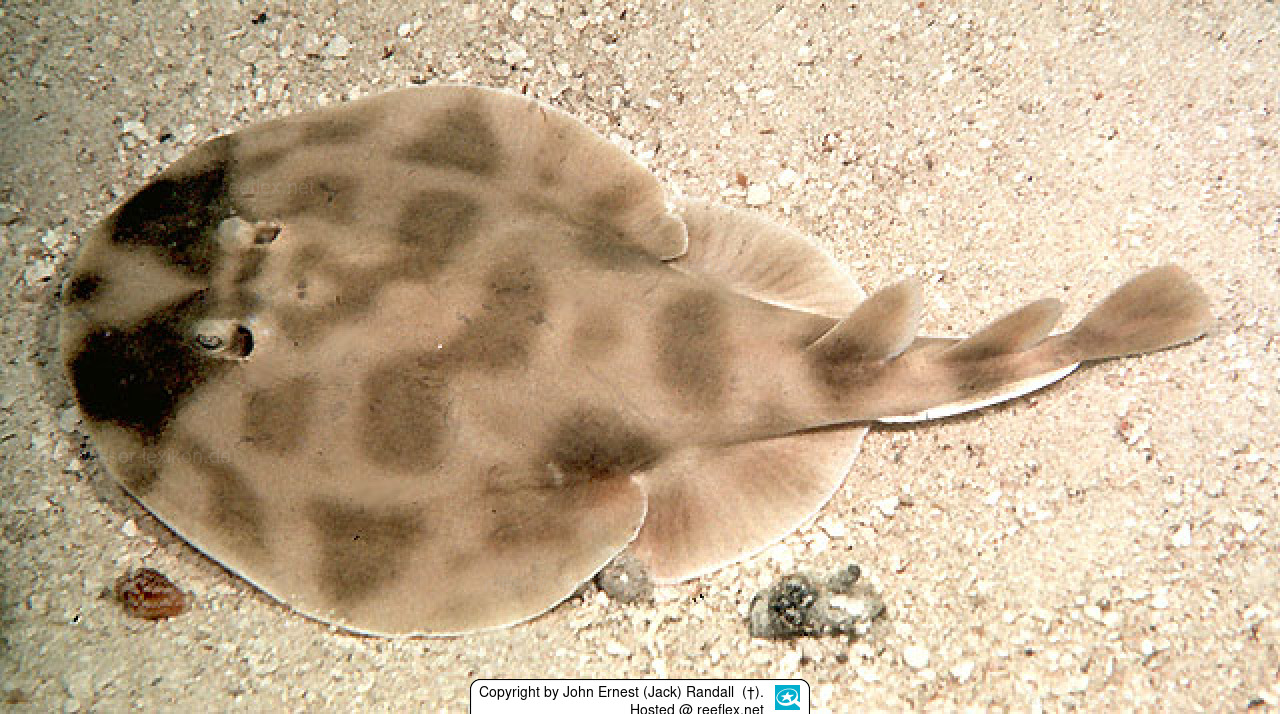
Narcine brasiliensis is a pale, sand-colored ray, often with ellipses of dark spots on the dorsal side of its round disc.
However, its coloration can vary from grayish brown to reddish brown.
The ray has many round spots outlined with blackish blotches, as well as dark bands that extend across the tail to the dorsal fin.
The snout is darkly colored.
According to a study, the ray feeds 97.1% on polychaete, in this case largely the annelid Rashgua lobatus (Hartman, 1947), formerly named Notomastus lobatus.
Crustaceans and fish are ingested in very small numbers, decapods at 0.9%, juvenile sand eels just 0.3%, with unidentified dietary items making up the remainder of the diet at a rate of 1.6%.
Narcine brasiliensis is not a suitable animal for home aquariums and should remain in the sea.
Synonyms:
Narcine brachypleura Miranda Ribeiro, 1923
Torpedo brasiliensis Olfers, 1831
Torpedo ocellata Quoy & Gaimard, 1824
Narcine brasiliensis is a tremor ray that can deliver surges of electricity when disturbed or in danger.
These are surges of electricity that can knock a person over, although the peak voltage is only 14 to 37 volts.
For this reason, care should be taken not to poke, kick, touch or annoy these animals to avoid shocks.
Narcine brasiliensis is a pale, sand-colored ray, often with ellipses of dark spots on the dorsal side of its round disc.
However, its coloration can vary from grayish brown to reddish brown.
The ray has many round spots outlined with blackish blotches, as well as dark bands that extend across the tail to the dorsal fin.
The snout is darkly colored.
According to a study, the ray feeds 97.1% on polychaete, in this case largely the annelid Rashgua lobatus (Hartman, 1947), formerly named Notomastus lobatus.
Crustaceans and fish are ingested in very small numbers, decapods at 0.9%, juvenile sand eels just 0.3%, with unidentified dietary items making up the remainder of the diet at a rate of 1.6%.
Narcine brasiliensis is not a suitable animal for home aquariums and should remain in the sea.
Synonyms:
Narcine brachypleura Miranda Ribeiro, 1923
Torpedo brasiliensis Olfers, 1831
Torpedo ocellata Quoy & Gaimard, 1824


