


 Springer Link


Info
In 2020 and 2021, zoasnthid anemones were studied in the Alboran Sea (western Mediterranean) around Grenada, Spain.
During these investigations, two new Parazoanthus species were discovered and described, Parazoanthus franciscae and Parazoanthus brevitentacularis.
Here we present Parazoanthus brevitentacularis.
In this study, three different morphotypes of Parazoanthus brevitentacularis were found living in the Alboran Sea.
Parazoanthus brevitentacularis shows important differences in ecology and color compared to other morphotypes, growing on the sponge Petrosia spp. and more frequently on rock walls.
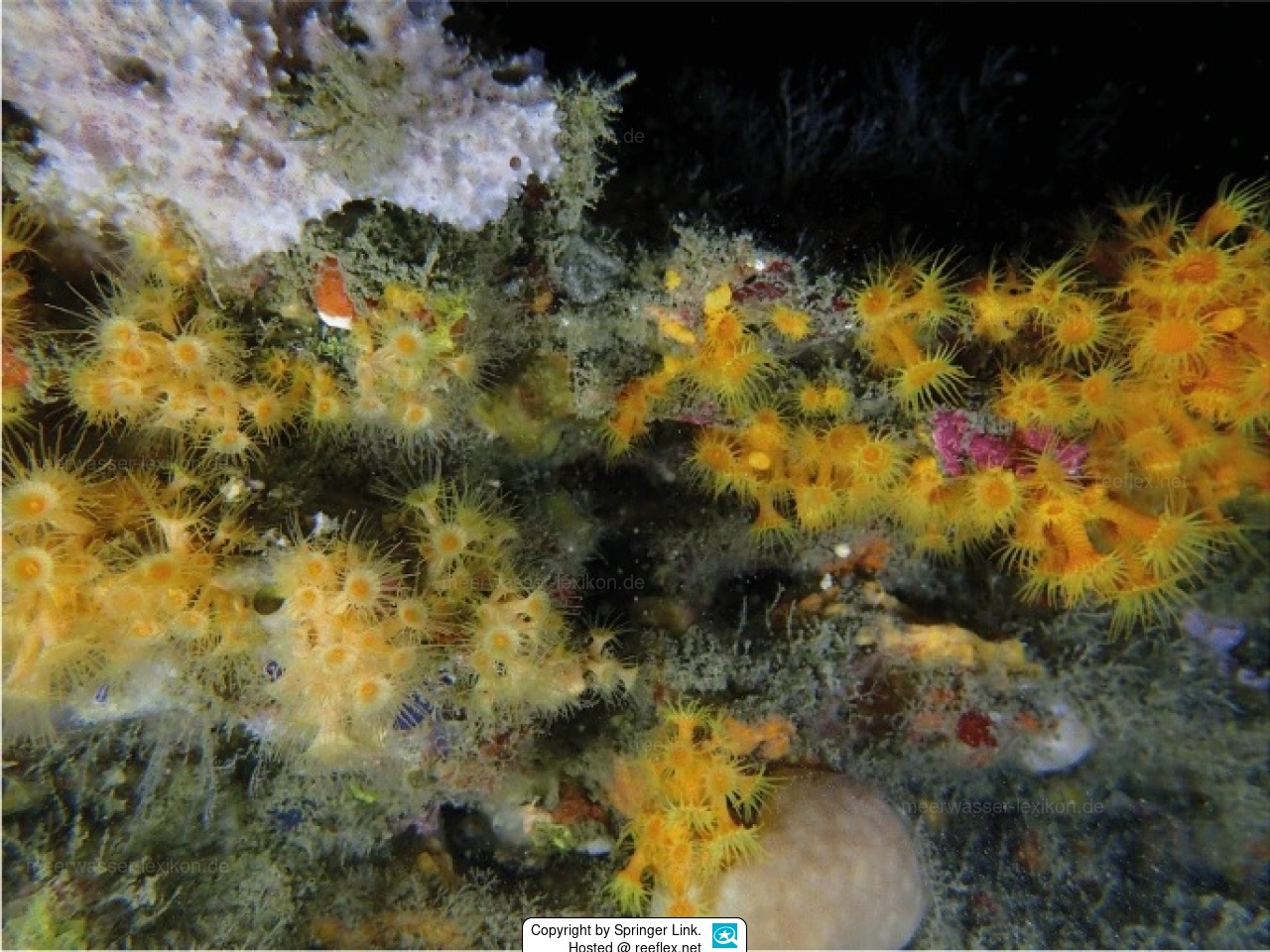
It has an unchanging orange column, which is usually encrusted with some mineral particles in the ectoderm, and the disc is also orange with distinct rays and thickenings, especially along the second tentacle cycle.
The populations are bound to rheophilic habitats and form large concentrations of polyps ranging from 1 to 40 meters, but unlike other morphotypes of Parazoanthus brevitentacularis, no growth on Axinella spp. has been observed.
Parazoanthus brevitentacularis has been found in the western Mediterranean and the Macaronesian archipelagos.
The researchers observed three different morphotypes of Parazoanthus brevitentacularis in the Alboran Sea in various underwater transects conducted in 2021 and 2022 using an ROV (Nido Robotics Sibiu Pro) and diving.
Samples were collected with SCUBA in the Special Area of Conservation (SAC) Calahonda-Castell de Ferro, Granada, Spain, in the SAC Punta de la Mona, Granada, Spain, in the Maro-Cerro Gordo Nature Reserve, Granada, Spain, in the SAC Chafarinas Islands, and in the Site of Community Importance (SCI) Monte Hacho, Ceuta, Spain.
First, the habitats and specimens were photographed with a compact Olympus TG-6 underwater camera. Colonies with 8–12 polyps were stored in separate bags underwater, taking special care to ensure that the morphotypes did not mix during the process.
Morphotype 1:
The “slender” morphotype includes various variants of yellowish specimens that grow almost exclusively on Axinella spp. but can also be found on rocky substrates at depths of 5 to 80 m.
The body column is completely covered with encrusted mineral particles that form a thick layer.
The tentacles and a nearby part of the disc are pale yellow, with an orange disc center and hypostome; the column is pink or yellowish throughout, but whitish near the tentacles (Ocaña et al. 2019).
This morphotype is widespread and occurs along the Mediterranean and northeast Atlantic coasts and is perhaps the most variable and could be polyphyletic.
Morphotype 2:
Populations of Parazoanthus brevitentacularis sensu lato, or “morphotype 2,” were found at all sites surveyed in a wide bathymetric range from 5 to at least 80 meters.
In Calahonda-Castell de Ferro SAC (Granada), they were observed growing sympatrically with Parazoanthus brevitentacularis and sharing the same rock walls.
Although the colonies are close to each other, they are separate and clearly distinguishable.
The presence of Parazoanthus brevitentacularis was confirmed again in Ceuta, Spain (Ocaña et al. 2019), and discovered for the first time in Granada, Spain, at Punta de la Mona (SAC) and Calahonda-Castell de Ferro SAC, where it mainly colonized rock walls.
Morphotype 3:
Another previously unclassified morphology with smaller individuals than those described above was found at all sites in Granada.
Colonies of this species were mainly observed as encrustations on walls and as parasites of Cliona spp. and Crambe crambe sponges in Punta de la Mona SAC, Cerro Gordo Natural Reserve, and Calahonda-Castell SAC at depths of 3 to 45 meters.
In the Calahonda-Castell de Ferro SAC, it was also observed in sympatry with Parazoanthus brevitentacularis sensu lato on a rock wall, but without mixing.
The tentacle morphology was abnormal in the area where the colonies of the two morphologies of the population were in contact.
Description of Parazoanthus brevitentacularis:
Parazoanthus brevitentacularis forms large colonies grouped in a common coenchyme and has thick and encrusting polyps with a well-developed ectoderm.
A sand encrustation was mainly observed under the ectoderm, widespread in the outer mesoglea.
The species is characterized by the uniform orange color of the entire body and the yellow or yellowish radial disc.
In living organisms, the body wall, capitulum, and oral disc are bright orange with thick, opaque tentacles; the capitulum has the distal radius of the first tentacle cycles in an intense yellow or orange color.
Mineral particles are present along the body wall but are particularly noticeable when retracted.
In preserved samples, the polyps are 0.3–1 cm high and have a diameter of 0.2–0.5 cm.
They are dark brown in color and show no signs of sand encrustations. All polyps are embedded in a common tissue connected by a base plate of coenchyme; no connection between the colonies has been found.
Parazoanthus brevitentacularis has four rows of 30–36 pointed tentacles, with the last row incomplete; the tentacles are usually shorter than or equal to the diameter of the spread-out mouth disc.
The species was mainly found on bare rocky cliffs or over calcareous algae at a depth of 15 to 30 meters.
In the Ceuta region, Parazoanthus brevitentacularis has been observed on the sponge Petrosia ficiformis.
Distribution
This species has been observed in the waters of the Mediterranean and Macaronesia (Ocaña et al. 2019).
There were no signs of the presence of zooxanthellae.
Synonym: Parazoanthus axinellae brevitentacularis Abel, 1959
Literature reference:
Rosales Ruiz, A., Ocaña, O., de la Herrán, R. et al.
Going deep into Parazoanthus axinellae (Anthozoa: Zoantharia) complex: description of two species in the Alboran Sea based on an integrative approach.
Mar. Biodivers. 55, 15 (2025). https://doi.org/10.1007/s12526-024-01493-x
Open access article / Offen zugänglicher Artikel
During these investigations, two new Parazoanthus species were discovered and described, Parazoanthus franciscae and Parazoanthus brevitentacularis.
Here we present Parazoanthus brevitentacularis.
In this study, three different morphotypes of Parazoanthus brevitentacularis were found living in the Alboran Sea.
Parazoanthus brevitentacularis shows important differences in ecology and color compared to other morphotypes, growing on the sponge Petrosia spp. and more frequently on rock walls.
It has an unchanging orange column, which is usually encrusted with some mineral particles in the ectoderm, and the disc is also orange with distinct rays and thickenings, especially along the second tentacle cycle.
The populations are bound to rheophilic habitats and form large concentrations of polyps ranging from 1 to 40 meters, but unlike other morphotypes of Parazoanthus brevitentacularis, no growth on Axinella spp. has been observed.
Parazoanthus brevitentacularis has been found in the western Mediterranean and the Macaronesian archipelagos.
The researchers observed three different morphotypes of Parazoanthus brevitentacularis in the Alboran Sea in various underwater transects conducted in 2021 and 2022 using an ROV (Nido Robotics Sibiu Pro) and diving.
Samples were collected with SCUBA in the Special Area of Conservation (SAC) Calahonda-Castell de Ferro, Granada, Spain, in the SAC Punta de la Mona, Granada, Spain, in the Maro-Cerro Gordo Nature Reserve, Granada, Spain, in the SAC Chafarinas Islands, and in the Site of Community Importance (SCI) Monte Hacho, Ceuta, Spain.
First, the habitats and specimens were photographed with a compact Olympus TG-6 underwater camera. Colonies with 8–12 polyps were stored in separate bags underwater, taking special care to ensure that the morphotypes did not mix during the process.
Morphotype 1:
The “slender” morphotype includes various variants of yellowish specimens that grow almost exclusively on Axinella spp. but can also be found on rocky substrates at depths of 5 to 80 m.
The body column is completely covered with encrusted mineral particles that form a thick layer.
The tentacles and a nearby part of the disc are pale yellow, with an orange disc center and hypostome; the column is pink or yellowish throughout, but whitish near the tentacles (Ocaña et al. 2019).
This morphotype is widespread and occurs along the Mediterranean and northeast Atlantic coasts and is perhaps the most variable and could be polyphyletic.
Morphotype 2:
Populations of Parazoanthus brevitentacularis sensu lato, or “morphotype 2,” were found at all sites surveyed in a wide bathymetric range from 5 to at least 80 meters.
In Calahonda-Castell de Ferro SAC (Granada), they were observed growing sympatrically with Parazoanthus brevitentacularis and sharing the same rock walls.
Although the colonies are close to each other, they are separate and clearly distinguishable.
The presence of Parazoanthus brevitentacularis was confirmed again in Ceuta, Spain (Ocaña et al. 2019), and discovered for the first time in Granada, Spain, at Punta de la Mona (SAC) and Calahonda-Castell de Ferro SAC, where it mainly colonized rock walls.
Morphotype 3:
Another previously unclassified morphology with smaller individuals than those described above was found at all sites in Granada.
Colonies of this species were mainly observed as encrustations on walls and as parasites of Cliona spp. and Crambe crambe sponges in Punta de la Mona SAC, Cerro Gordo Natural Reserve, and Calahonda-Castell SAC at depths of 3 to 45 meters.
In the Calahonda-Castell de Ferro SAC, it was also observed in sympatry with Parazoanthus brevitentacularis sensu lato on a rock wall, but without mixing.
The tentacle morphology was abnormal in the area where the colonies of the two morphologies of the population were in contact.
Description of Parazoanthus brevitentacularis:
Parazoanthus brevitentacularis forms large colonies grouped in a common coenchyme and has thick and encrusting polyps with a well-developed ectoderm.
A sand encrustation was mainly observed under the ectoderm, widespread in the outer mesoglea.
The species is characterized by the uniform orange color of the entire body and the yellow or yellowish radial disc.
In living organisms, the body wall, capitulum, and oral disc are bright orange with thick, opaque tentacles; the capitulum has the distal radius of the first tentacle cycles in an intense yellow or orange color.
Mineral particles are present along the body wall but are particularly noticeable when retracted.
In preserved samples, the polyps are 0.3–1 cm high and have a diameter of 0.2–0.5 cm.
They are dark brown in color and show no signs of sand encrustations. All polyps are embedded in a common tissue connected by a base plate of coenchyme; no connection between the colonies has been found.
Parazoanthus brevitentacularis has four rows of 30–36 pointed tentacles, with the last row incomplete; the tentacles are usually shorter than or equal to the diameter of the spread-out mouth disc.
The species was mainly found on bare rocky cliffs or over calcareous algae at a depth of 15 to 30 meters.
In the Ceuta region, Parazoanthus brevitentacularis has been observed on the sponge Petrosia ficiformis.
Distribution
This species has been observed in the waters of the Mediterranean and Macaronesia (Ocaña et al. 2019).
There were no signs of the presence of zooxanthellae.
Synonym: Parazoanthus axinellae brevitentacularis Abel, 1959
Literature reference:
Rosales Ruiz, A., Ocaña, O., de la Herrán, R. et al.
Going deep into Parazoanthus axinellae (Anthozoa: Zoantharia) complex: description of two species in the Alboran Sea based on an integrative approach.
Mar. Biodivers. 55, 15 (2025). https://doi.org/10.1007/s12526-024-01493-x
Open access article / Offen zugänglicher Artikel


