


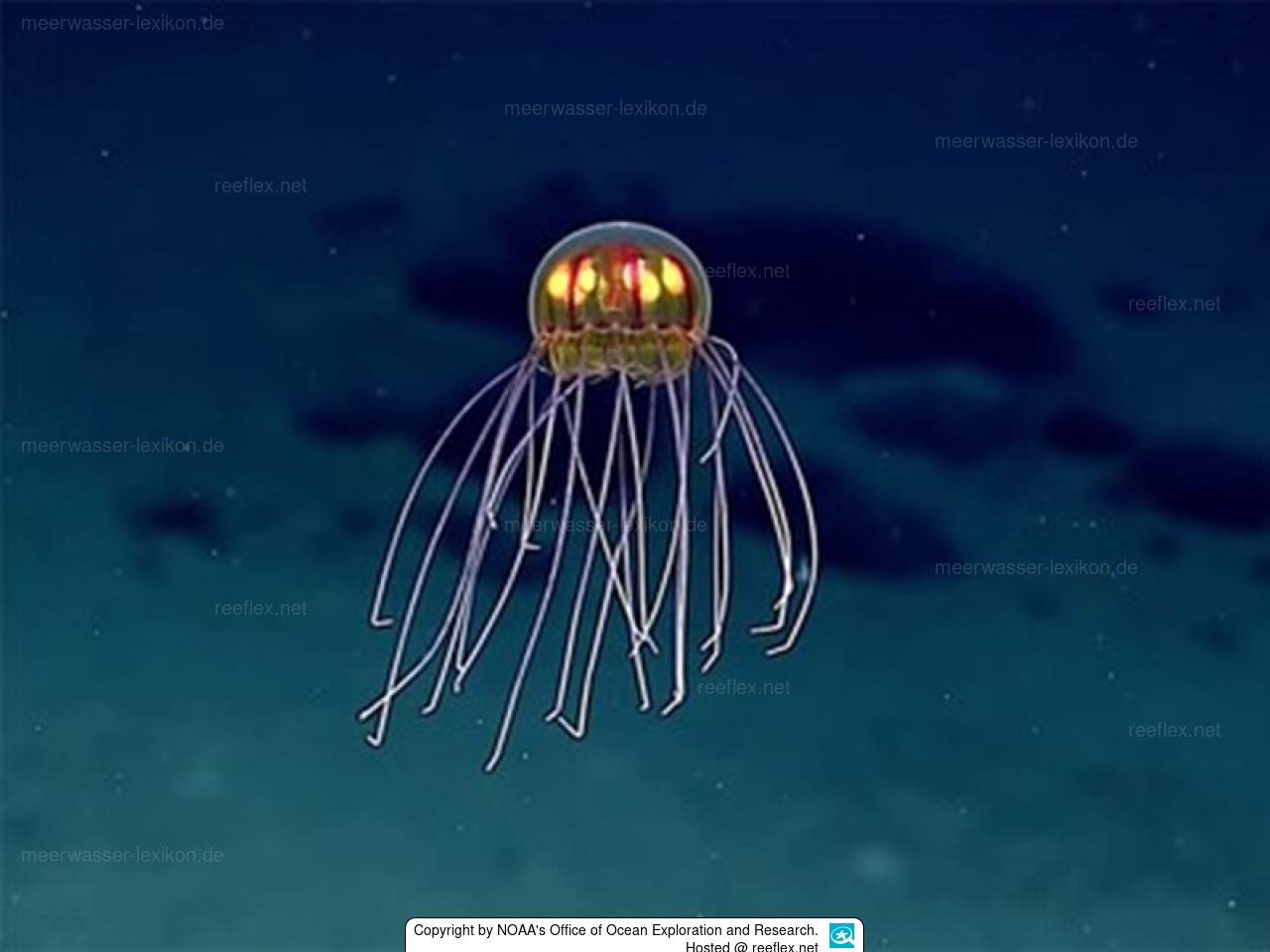
 NOAA's Office of Ocean Exploration and Research

Info
The deep sea is a world full of secrets; even the surface of the moon has been better explored than the depths of our oceans!
Sources: Greenpeace, Alfred Wegener Institute (AWI), Deutsche Welle (DW).
During dive 366 of the ROV Tiburon on October 4, 2001, a female specimen of Crossota millsae, 17 mm in height and carrying developing young, was collected at a depth of 2540 meters off Monterey, California.
Two days earlier, a male specimen measuring 12.5 mm in height was collected at a depth of 3244 meters by the same ROV.
In March 1995, six juveniles were landed by the Mother Tucker Trawl in the San Clemente Basin off southern California.
Crossota millsae has a bell with a maximum diameter of 28 mm and a height of 18 mm.
The inner bell pigmentation is burnt tangerine.
The manubrium and gonads are light pink to lavender, the mesoglea is colorless, and there is no stalk.
The outer bell is almost hemispherical to slightly conical with numerous exumbrellar furrows; it is more fragile than in other Crossota species.
Deep-sea luminous jellyfish has 220 tentacles in a row with rings of stinging cells.
The sexually dimorphic gonads are located about 4 mm from the manubrium; the testes are hanging sausages, the ovaries are spherical, and the eggs develop into young animals while attached to the mother.
Juveniles reach a diameter of 5 mm, are pink in color with orange tentacles and clear radial canals.
Their tentacles are arranged in groups (3–4 each) alternately per- and interradially.
This species belongs to the genus Crossota (Kramp 1968) due to its hanging gonads, exumbrellar furrows, lack of a stalk, and lack of centripetal extensions in the ring canal.
These characteristics distinguish it from the closely related genera Vampyrocrossota Thuesen, 1993, Benthocodon Larson & Harbison, 1990, and Voragonema Naumov, 1971.
This species differs from other species of the genus Crossota in its pigmentation, the location of the gonads, and the arrangement of the tentacle abscission zone, which leaves a characteristic wavy fringe of tentacle bases after abscission.
The bright colors and unusual appearance of this jellyfish alerted scientists to a unique find.
Of all the jellyfish that inhabit the midnight zone of the ocean, the psychedelic jellyfish (Crossota millsae) is one of the most impressive.
Its wild, colorful appearance—ruby red, bright orange, and electric purple—initially led scientists to believe that they had discovered a previously unknown species.
Upon closer inspection, however, another surprise awaited the scientists: this species is one of the few jellyfish that give birth to live young!
The female psychedelic jellyfish incubates her babies in the purple-red channels that spread throughout her bell-shaped body.
The mother carries more than one baby at a time. Her babies can vary in size, indicating different stages of development.
The developing young are fed by their mother.
Under the protection of her bell, the little jellyfish grow larger and even develop tentacles while still attached to their mother.
When a young jellyfish outgrows its protection, it detaches itself and swims away to live its own life.
As the young jellyfish grows, its lavender color fades and it develops the mandarin-colored pigmentation typical of adults.
The glow, called bioluminescence, can have the following reasons, among others:
- Light signals can help in the search for a mate
- Glowing in the dark attracts prey
- Spontaneous flashing can scare and confuse predators.
Other areas where they are found include the Canada Basin, Northwind Ridge, the Chukchi Plateau, and the Chukchi Cap.
Sources: Greenpeace, Alfred Wegener Institute (AWI), Deutsche Welle (DW).
During dive 366 of the ROV Tiburon on October 4, 2001, a female specimen of Crossota millsae, 17 mm in height and carrying developing young, was collected at a depth of 2540 meters off Monterey, California.
Two days earlier, a male specimen measuring 12.5 mm in height was collected at a depth of 3244 meters by the same ROV.
In March 1995, six juveniles were landed by the Mother Tucker Trawl in the San Clemente Basin off southern California.
Crossota millsae has a bell with a maximum diameter of 28 mm and a height of 18 mm.
The inner bell pigmentation is burnt tangerine.
The manubrium and gonads are light pink to lavender, the mesoglea is colorless, and there is no stalk.
The outer bell is almost hemispherical to slightly conical with numerous exumbrellar furrows; it is more fragile than in other Crossota species.
Deep-sea luminous jellyfish has 220 tentacles in a row with rings of stinging cells.
The sexually dimorphic gonads are located about 4 mm from the manubrium; the testes are hanging sausages, the ovaries are spherical, and the eggs develop into young animals while attached to the mother.
Juveniles reach a diameter of 5 mm, are pink in color with orange tentacles and clear radial canals.
Their tentacles are arranged in groups (3–4 each) alternately per- and interradially.
This species belongs to the genus Crossota (Kramp 1968) due to its hanging gonads, exumbrellar furrows, lack of a stalk, and lack of centripetal extensions in the ring canal.
These characteristics distinguish it from the closely related genera Vampyrocrossota Thuesen, 1993, Benthocodon Larson & Harbison, 1990, and Voragonema Naumov, 1971.
This species differs from other species of the genus Crossota in its pigmentation, the location of the gonads, and the arrangement of the tentacle abscission zone, which leaves a characteristic wavy fringe of tentacle bases after abscission.
The bright colors and unusual appearance of this jellyfish alerted scientists to a unique find.
Of all the jellyfish that inhabit the midnight zone of the ocean, the psychedelic jellyfish (Crossota millsae) is one of the most impressive.
Its wild, colorful appearance—ruby red, bright orange, and electric purple—initially led scientists to believe that they had discovered a previously unknown species.
Upon closer inspection, however, another surprise awaited the scientists: this species is one of the few jellyfish that give birth to live young!
The female psychedelic jellyfish incubates her babies in the purple-red channels that spread throughout her bell-shaped body.
The mother carries more than one baby at a time. Her babies can vary in size, indicating different stages of development.
The developing young are fed by their mother.
Under the protection of her bell, the little jellyfish grow larger and even develop tentacles while still attached to their mother.
When a young jellyfish outgrows its protection, it detaches itself and swims away to live its own life.
As the young jellyfish grows, its lavender color fades and it develops the mandarin-colored pigmentation typical of adults.
The glow, called bioluminescence, can have the following reasons, among others:
- Light signals can help in the search for a mate
- Glowing in the dark attracts prey
- Spontaneous flashing can scare and confuse predators.
Other areas where they are found include the Canada Basin, Northwind Ridge, the Chukchi Plateau, and the Chukchi Cap.

