



 Wiley Online Library


Info
Two new deep-sea corals, Anthomastus sphaericus and Anthomastus mirabilis, were discovered in 2017 and 2019 on an underwater mountain in the northwestern Pacific Ocean, located in the Caroline Island Ridge, and described in 2025.
The genus Anthomastus is the first established and most frequently studied genus of mushroom soft corals among octocoral taxonomists and related researchers.
In this study, the authors restrict Anthomastus to those species whose siphonozooids are confined to the capitulum and introduce the new genus Neoanthomastus for species whose siphonozooids extend into the stem.
Consequently, the four species Anthomastus giganteus, Anthomastus hicksoni, Anthomastus purpureus, and Anthomastus tahinodus are placed in Neoanthomastus as Neoanthomastus giganteus (Tixier-Durivault, 1954), Neoanthomastus hicksoni (Bock, 1938), Neoanthomastus purpureus (Koren and Danielssen, 1883), and Neoanthomastus tahinodus (d'Hondt, 1988).
Colonies of the genus Anthomastus i are hemispherical to cap-shaped with a dome-shaped capitulum that gradually transitions into the attachment device via an inconspicuous stalk, or mushroom-shaped with a conspicuous stalk.
The polyps are dimorphic and contain sclerites. The autozooids are distributed over the capitulum, retractable, and relatively large.
Sclerites are evenly developed on the dorsal and ventral sides of the autozooids.
All siphonozooids are confined to the capitulum, fertile, and numerous.
These sclerites include needles, rods, multirams, warty clubs, plates, spindles, and tuberculate double spheres.
Pharyngeal sclerites are predominantly plates, rods, or absent, while tentacular sclerites are predominantly rods, plates, and crosses.
In life, the animal adheres to a hard substrate. The head-shaped colony was 50 mm long, with a short stalk approximately 22 mm long and 19 × 10 mm wide.
It originates from a membrane-like, spreading adhesive disc.
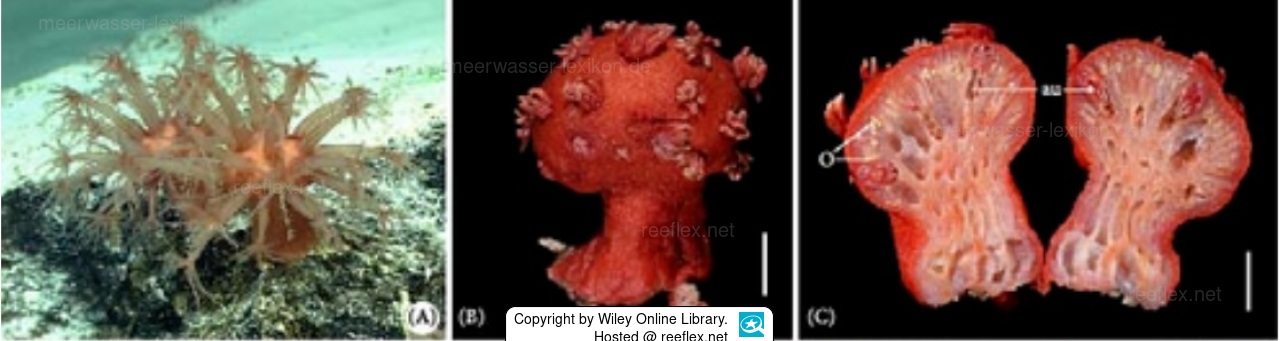
The capitulum protrudes from the stalk, almost spherical, 42 × 33 mm wide and 28 mm long (occupying 56% of the total length of the colony) and bears 27 autozooids (Figure 4B,C).
The holotype: MBM286336, was collected on August 20, 2017, at station FX-Dive 136 of the M4 seamount at a water depth of 1435 meters; the paratypes: MBM286337 and MBM286338, were each collected with one specimen, together with the holotype.
Both paratypes have the same colony shape as the holotype. Paratype MBM286337 was 46 mm long, with a capitulum measuring 40 × 36 mm in diameter and 28 mm in length, bearing 34 autozooids, and a stalk measuring 22 × 12 mm in diameter and 18 mm in length.
The paratype MBM286338 was 31 mm long, with a capitulum 30 × 25 mm in diameter and 22 mm long, bearing 20 autozooids, and a stalk 23 × 14 mm in diameter and 9 mm long.
Etymology
The species name, a Greek adjective, “sphaericus,” refers to the spherical capitulum of this species.
Distribution and habitat
Anthomastus sphaericus has so far only been found on the M4 Seamount in the tropical northwest Pacific, where the water depth was 1435 meters and the temperature was around 2.9 °C.
The genus Anthomastus is the first established and most frequently studied genus of mushroom soft corals among octocoral taxonomists and related researchers.
In this study, the authors restrict Anthomastus to those species whose siphonozooids are confined to the capitulum and introduce the new genus Neoanthomastus for species whose siphonozooids extend into the stem.
Consequently, the four species Anthomastus giganteus, Anthomastus hicksoni, Anthomastus purpureus, and Anthomastus tahinodus are placed in Neoanthomastus as Neoanthomastus giganteus (Tixier-Durivault, 1954), Neoanthomastus hicksoni (Bock, 1938), Neoanthomastus purpureus (Koren and Danielssen, 1883), and Neoanthomastus tahinodus (d'Hondt, 1988).
Colonies of the genus Anthomastus i are hemispherical to cap-shaped with a dome-shaped capitulum that gradually transitions into the attachment device via an inconspicuous stalk, or mushroom-shaped with a conspicuous stalk.
The polyps are dimorphic and contain sclerites. The autozooids are distributed over the capitulum, retractable, and relatively large.
Sclerites are evenly developed on the dorsal and ventral sides of the autozooids.
All siphonozooids are confined to the capitulum, fertile, and numerous.
These sclerites include needles, rods, multirams, warty clubs, plates, spindles, and tuberculate double spheres.
Pharyngeal sclerites are predominantly plates, rods, or absent, while tentacular sclerites are predominantly rods, plates, and crosses.
In life, the animal adheres to a hard substrate. The head-shaped colony was 50 mm long, with a short stalk approximately 22 mm long and 19 × 10 mm wide.
It originates from a membrane-like, spreading adhesive disc.
The capitulum protrudes from the stalk, almost spherical, 42 × 33 mm wide and 28 mm long (occupying 56% of the total length of the colony) and bears 27 autozooids (Figure 4B,C).
The holotype: MBM286336, was collected on August 20, 2017, at station FX-Dive 136 of the M4 seamount at a water depth of 1435 meters; the paratypes: MBM286337 and MBM286338, were each collected with one specimen, together with the holotype.
Both paratypes have the same colony shape as the holotype. Paratype MBM286337 was 46 mm long, with a capitulum measuring 40 × 36 mm in diameter and 28 mm in length, bearing 34 autozooids, and a stalk measuring 22 × 12 mm in diameter and 18 mm in length.
The paratype MBM286338 was 31 mm long, with a capitulum 30 × 25 mm in diameter and 22 mm long, bearing 20 autozooids, and a stalk 23 × 14 mm in diameter and 9 mm long.
Etymology
The species name, a Greek adjective, “sphaericus,” refers to the spherical capitulum of this species.
Distribution and habitat
Anthomastus sphaericus has so far only been found on the M4 Seamount in the tropical northwest Pacific, where the water depth was 1435 meters and the temperature was around 2.9 °C.

