


 iNaturalist Open Source Software


Info
Diplodus argenteus prefers shallow coastal waters along open rocky coasts, mostly in the surf zone, especially in clear water above rocky and coral bottoms/reefs.
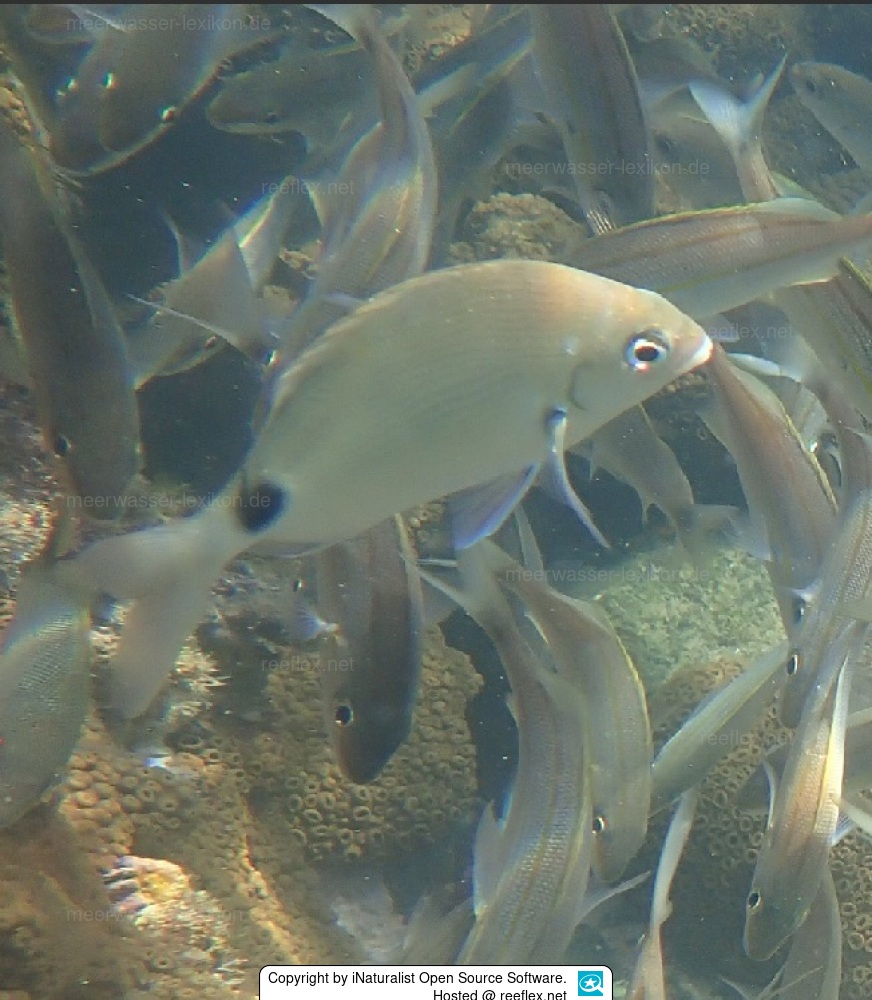
Juvenile bream are found in coastal waters between rocks and in sea grass beds, where they form shoals and find protection within the mass.
Juvenile fish feed primarily on algae and only develop additional carnivorous feeding behavior as they grow.
Juvenile fish are also often found near piers, jetties, rocks, and natural reefs.
Diplodus argenteus is a diurnal species, but can also be found at night, see photo no. 1 by agujaceratops.
This sea bream is characterized by a distinctive dark spot on the tail fin stalk, which is significantly lighter in juvenile animals.
Etymology:
The species name “argenteus” is a Latin adjective meaning “silver,” “made of silver,” or “silver-colored” (from argentum = silver), referring to the silver-colored scales of the species.
Synonyms:
Diplodus argenteus argenteus (Valenciennes, 1830) · alternative representation
Sargus argenteus Valenciennes, 1830 · unaccepted
Sparus sargo Larrañaga, 1923 · unaccepted
Juvenile bream are found in coastal waters between rocks and in sea grass beds, where they form shoals and find protection within the mass.
Juvenile fish feed primarily on algae and only develop additional carnivorous feeding behavior as they grow.
Juvenile fish are also often found near piers, jetties, rocks, and natural reefs.
Diplodus argenteus is a diurnal species, but can also be found at night, see photo no. 1 by agujaceratops.
This sea bream is characterized by a distinctive dark spot on the tail fin stalk, which is significantly lighter in juvenile animals.
Etymology:
The species name “argenteus” is a Latin adjective meaning “silver,” “made of silver,” or “silver-colored” (from argentum = silver), referring to the silver-colored scales of the species.
Synonyms:
Diplodus argenteus argenteus (Valenciennes, 1830) · alternative representation
Sargus argenteus Valenciennes, 1830 · unaccepted
Sparus sargo Larrañaga, 1923 · unaccepted

