



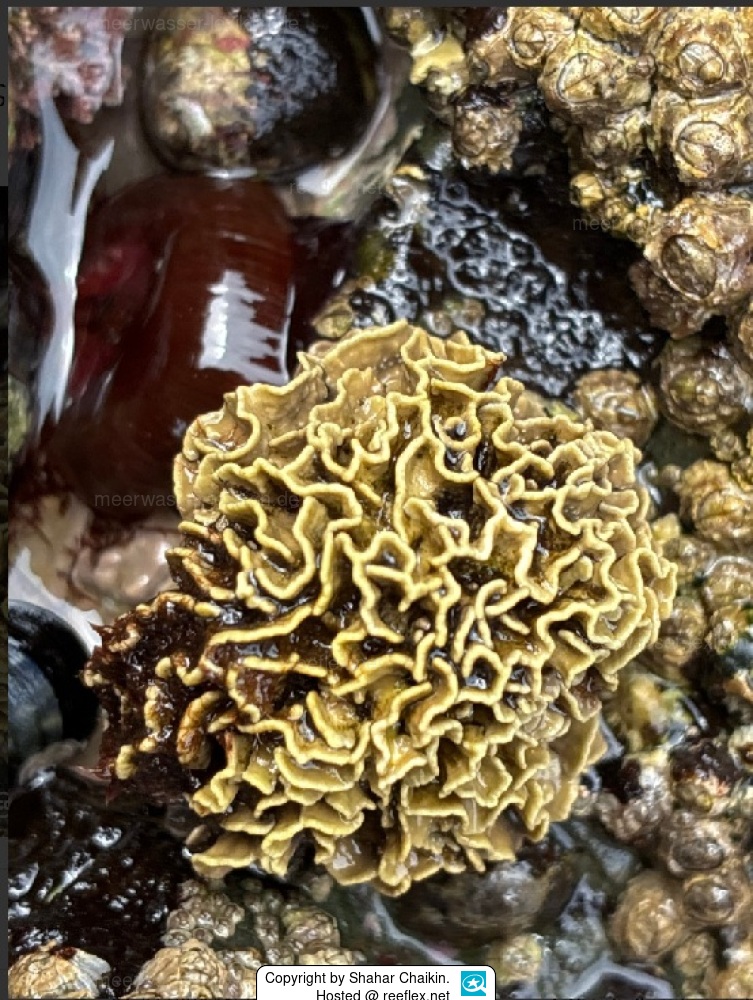
 Dr. Shahar Chaikin, Israel


Info
Many people interested in the subject know that there are reef-building corals—that is, animals that actively help build reefs through their calcium carbonate production and life cycle (e.g., Acropora stony corals)—and corals that do not contribute to reef building, such as soft corals.
Few people are aware, however, that there are marine algae that also actively and long-term influence and help shape their habitat—specifically, certain types of marine algae.
These so-called “coral algae” are marine algae that incorporate calcium carbonate (limestone) into their cell walls, giving them a hard, rock-like structure.
They are the “silent architects,” the ecosystem shapers of the oceans, and therefore play a crucial role in reef formation.
Lithophyllum byssoides is one such calcareous red alga that forms pinkish-white, calcified crusts on wave-exposed rocks in the intertidal zone.
The colonies merge to form distinct horizontal ridges that protrude from the host rock.
Calcareous red algae are a characteristic reef-building species on wave-exposed rocky coasts of the Mediterranean; they thrive in rocky and shaded habitats, in both semi-protected and exposed locations, just above mean sea level.
The incorporation of calcium carbonate stabilizes and protects the marine algae; however, they are still sensitive to rising sea levels and are therefore also used as geological markers.
Intense sunlight and high temperatures cause Lithophyllum byssoides to dry out and bleach.
Predators:
Most algae-eaters avoid these stony red algae.
However, a few animals with particularly keratinized mouthparts—such as young abalones, certain sea snails, and one species of chiton (Tonicella lineata)—preferentially feed on coral algae.
Synonyms:
Goniolithon byssoides (Lamarck) Foslie, 1898 · unaccepted
Lithophyllum lichenoides Philippi, 1837 · unaccepted (synonym)
Lithothamnion byssoides (Lamarck) Philippi, 1837 · unaccepted
Lithothamnium byssoides (Lamarck) Philippi, 1837 · unaccepted
Melobesia lichenoides (Philippi) Endlicher, 1843 · unaccepted (synonym)
Millepora byssoides (Lamarck, 1801) Lamarck, 1816 · unaccepted > superseded combination (the name of the hydrocoral genus...)
Nullipora byssoides Lamarck, 1801 · unaccepted (synonym)
Spongites byssoides (Lamarck) Kützing, 1869 · unaccepted
Titanoderma byssoides (Lamarck) Y.M.Chamberlain & Woelkerling, 1988 · unaccepted (synonym)
Few people are aware, however, that there are marine algae that also actively and long-term influence and help shape their habitat—specifically, certain types of marine algae.
These so-called “coral algae” are marine algae that incorporate calcium carbonate (limestone) into their cell walls, giving them a hard, rock-like structure.
They are the “silent architects,” the ecosystem shapers of the oceans, and therefore play a crucial role in reef formation.
Lithophyllum byssoides is one such calcareous red alga that forms pinkish-white, calcified crusts on wave-exposed rocks in the intertidal zone.
The colonies merge to form distinct horizontal ridges that protrude from the host rock.
Calcareous red algae are a characteristic reef-building species on wave-exposed rocky coasts of the Mediterranean; they thrive in rocky and shaded habitats, in both semi-protected and exposed locations, just above mean sea level.
The incorporation of calcium carbonate stabilizes and protects the marine algae; however, they are still sensitive to rising sea levels and are therefore also used as geological markers.
Intense sunlight and high temperatures cause Lithophyllum byssoides to dry out and bleach.
Predators:
Most algae-eaters avoid these stony red algae.
However, a few animals with particularly keratinized mouthparts—such as young abalones, certain sea snails, and one species of chiton (Tonicella lineata)—preferentially feed on coral algae.
Synonyms:
Goniolithon byssoides (Lamarck) Foslie, 1898 · unaccepted
Lithophyllum lichenoides Philippi, 1837 · unaccepted (synonym)
Lithothamnion byssoides (Lamarck) Philippi, 1837 · unaccepted
Lithothamnium byssoides (Lamarck) Philippi, 1837 · unaccepted
Melobesia lichenoides (Philippi) Endlicher, 1843 · unaccepted (synonym)
Millepora byssoides (Lamarck, 1801) Lamarck, 1816 · unaccepted > superseded combination (the name of the hydrocoral genus...)
Nullipora byssoides Lamarck, 1801 · unaccepted (synonym)
Spongites byssoides (Lamarck) Kützing, 1869 · unaccepted
Titanoderma byssoides (Lamarck) Y.M.Chamberlain & Woelkerling, 1988 · unaccepted (synonym)


