


 ZooKeys

Info
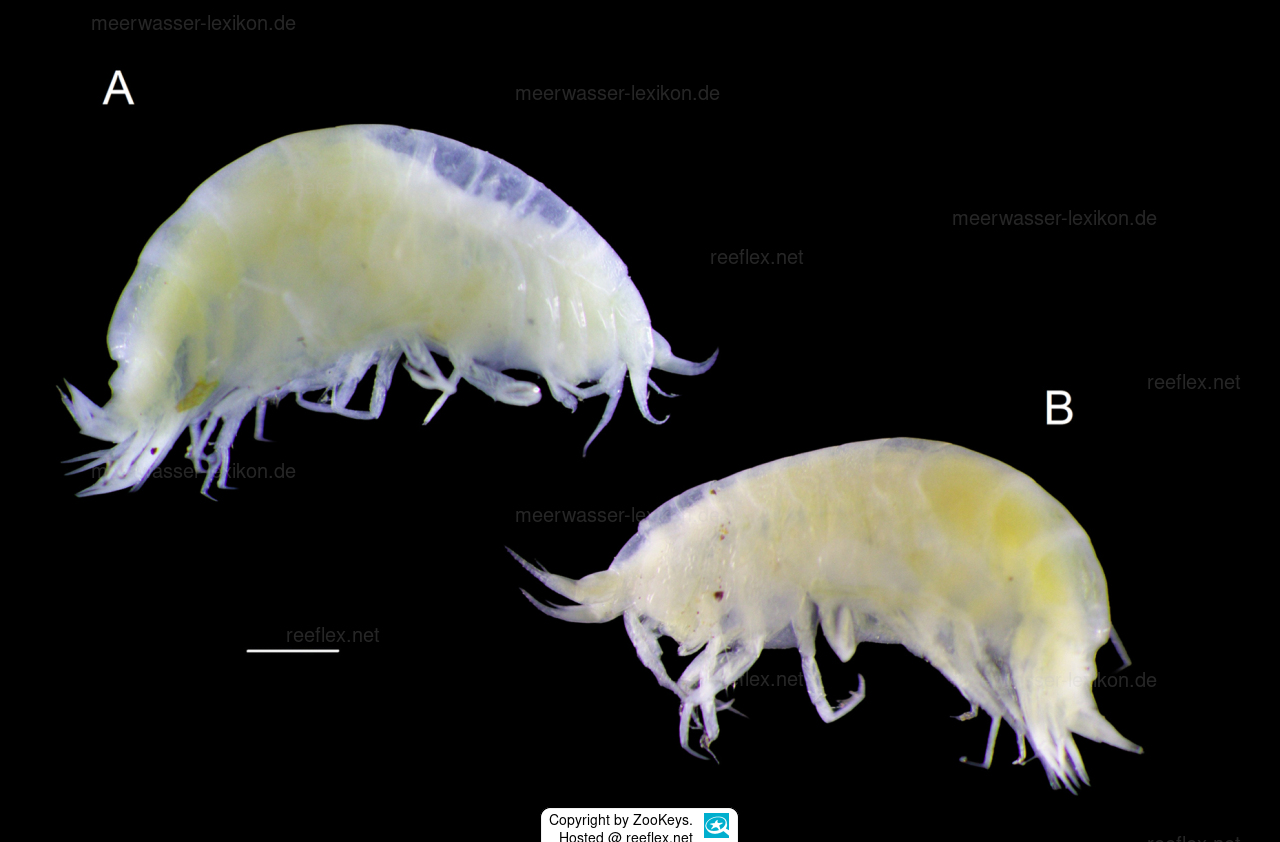
A new species of deep-sea amphipod has been discovered on the Porcupine Deep-Sea Plain, also known as the Porcupine Abyssal Plain, a deep-sea plain in the northeastern Atlantic, southwest of Ireland.
Etymology.
The species was named in honor of the “Porcupine Abyssal Plain Sustained Observatory” (PAP-SO), in recognition of the four decades of multidisciplinary scientific research conducted at this site.
Caeconyx papso was first identified in 1985 (Expedition CH6A/85) by one of the authors (MHT) as a potential new species (provisionally assigned to the genus Paracentromedon), marking the beginning of the time series on scavenging amphipods at PAP-SO.
Since then, over the course of 40 years of trapping for scavenging amphipods at PAP-SO, 54 specimens of Caeconyx papso have been identified, with the most recent specimen identified in 2024.
Question: What is the most sought-after food source for these amphipods and other scavengers, such as polychaetes and others?
Answer: A whale carcass, as it provides a plentiful food source for a long time.
Reference:
Walker B, Thurston MH, Bribiesca-Contreras G, Horton T (2026) A new deep-water scavenger species in the genus Caeconyx (Crustacea, Amphipoda, Lysianassoidea, Uristidae) from the Porcupine Abyssal Plain. ZooKeys 1282: 267–286. https://doi.org/10.3897/zookeys.1282.191061
This is an open-access article distributed under the terms of the Creative Commons Attribution (CC BY 4.0) license, which permits unrestricted use, distribution, and reproduction in any medium, provided the original author and source are credited.
Etymology.
The species was named in honor of the “Porcupine Abyssal Plain Sustained Observatory” (PAP-SO), in recognition of the four decades of multidisciplinary scientific research conducted at this site.
Caeconyx papso was first identified in 1985 (Expedition CH6A/85) by one of the authors (MHT) as a potential new species (provisionally assigned to the genus Paracentromedon), marking the beginning of the time series on scavenging amphipods at PAP-SO.
Since then, over the course of 40 years of trapping for scavenging amphipods at PAP-SO, 54 specimens of Caeconyx papso have been identified, with the most recent specimen identified in 2024.
Question: What is the most sought-after food source for these amphipods and other scavengers, such as polychaetes and others?
Answer: A whale carcass, as it provides a plentiful food source for a long time.
Reference:
Walker B, Thurston MH, Bribiesca-Contreras G, Horton T (2026) A new deep-water scavenger species in the genus Caeconyx (Crustacea, Amphipoda, Lysianassoidea, Uristidae) from the Porcupine Abyssal Plain. ZooKeys 1282: 267–286. https://doi.org/10.3897/zookeys.1282.191061
This is an open-access article distributed under the terms of the Creative Commons Attribution (CC BY 4.0) license, which permits unrestricted use, distribution, and reproduction in any medium, provided the original author and source are credited.

