



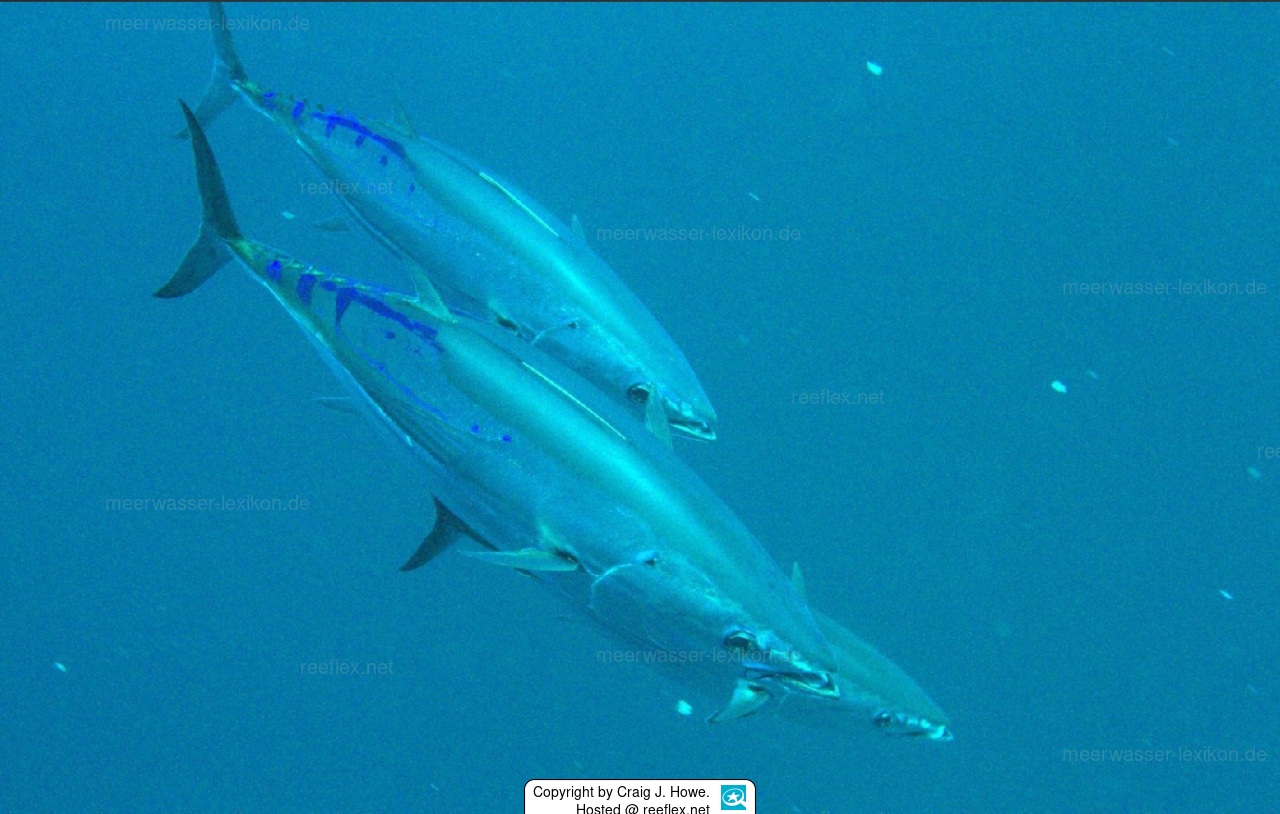
 Craig J. Howe, Australien

Info
Katsuwonus pelamis is a very widespread and fast-swimming tuna that is intensively targeted by commercial fisheries; it is also one of the game fish that demands a great deal of strength and endurance from anglers.
$fish poisoning
True bonitos are pelagic and oceanodromous fish found in offshore waters at depths of up to 330 meters (Collette and Graves 2019); Schaefer and Fuller (2007) documented a dive to a depth of 596 meters. I
Their lower temperature limit appears to be around 18 °C, but the upper temperature limit apparently varies depending on size—from 30 °C or more for small fish down to 25 °C for the largest specimens.
Katsuwonus pelamis is also restricted to waters with unusually high concentrations of dissolved oxygen, which must be at least 3.0–3.5 ml/l (4–5 ppm) for long-term survival.
Larvae are found from the lower part of the mixed layer to the upper part of the thermocline within a temperature range of 20–25 °C and a salinity range of 33.6–35.5.
True bonito have a strong tendency to form schools in surface waters, often in association with floating objects, sharks, and whales; however, this does not appear to be the case in the Mediterranean, where they frequently form mixed schools with small yellowfin tuna (Thunnus albacares) and bigeye tuna (Thunnus obesus), and in the western Atlantic, they are frequently found in schools with blackfin tuna (Thunnus atlanticus).
True bonito grow very quickly, have relatively short lifespans, and are extremely prolific (Collette and Graves 2019).
Life expectancy, calculated based on growth rings on the first dorsal fin or the sagittal otolith, is estimated to be at least seven years (Collette and Graves 2019).
The age at first sexual maturity is estimated to be 1.5 years (Maunder and Harley 2005).
In the western and central Pacific, about 50% of the fish are sexually mature at 0.75 years of age, and more than 90% of the fish reach sexual maturity after about 1.5 years (WCPFC, 2019b).
The size at first sexual maturity ranges from 40 to 55 cm fork length (FL), depending on the region (Collette and Nauen 1983, Matsumoto et al. 1984, Wild and Hampton 1994, Schaefer 2001).
The sex ratio is approximately 1:1; however, in fisheries targeting young, immature fish, females predominate, whereas in those targeting older fish, males predominate.
This species spawns repeatedly after reaching sexual maturity and having sufficient energy reserves, at sea surface temperatures of 24–30 °C: year-round in the Caribbean and other equatorial waters, and from spring through early fall in subtropical waters, with the spawning season becoming shorter with increasing distance from the equator.
The size of individual clutches ranges from 80,000 eggs in a 44-cm-long female from Madagascar to 1.25 million eggs in a large (75-cm) female from the Seychelles (Collette 2010, Collette and Graves 2019).
The largest size ever recorded is 111 cm FL and 34.5 kg (Bayliff 1988, Garcia-Coll et al. 1986, Collette 2010, Collette and Graves 2019).
The IGFA record for sport fishing using all methods is 20.54 kg for a heavy skipjack caught in November 1996 over the Flathead Bank in Baja California, Mexico (IGFA 2020).
The generation time for this species is estimated at 3–4 years using the methods of Collette et al. 2011, which is why changes in population size are estimated over a 10-year period.
Katsuwonus pelamis is preyed upon by large pelagic fish, particularly marlin, sailfish, and swordfish.
Synonyms:
Euthynnus pelamis (Linnaeus, 1758) · unaccepted (subsequent combination)
Euthynnus pelamys (Linnaeus, 1758) · unaccepted (misspelling)
Gymnosarda pelamis (Linnaeus, 1758) · unaccepted
Gymnosarda pelamys (Linnaeus, 1758) · unaccepted (misspelling)
Katsowonus pelamis (Linnaeus, 1758) · unaccepted (misspelling)
Katsuwinus pelamis (Linnaeus, 1758) · unaccepted (misspelling)
Katsuwonis pelamis (Linnaeus, 1758) · unaccepted > misspelling - incorrect subsequent spelling
Katsuwonnus pelamis (Linnaeus, 1758) · unaccepted (misspelling)
Katsuwonus pelamsi (Linnaeus, 1758) · unaccepted (misspelling)
Katsuwonus pelamys (Linnaeus, 1758) · unaccepted (misspelling)
Katsuwonus vagans (Lesson, 1829) · unaccepted
Katuswonis pelamis (Linnaeus, 1758) · unaccepted > misspelling - incorrect subsequent spelling
Orcynus pelamis (Linnaeus, 1758) · unaccepted
Orcynus pelamys (Linnaeus, 1758) · unaccepted (misspelling)
Scomber pelamides Lacepède, 1801 · unaccepted
Scomber pelamis Linnaeus, 1758 · unaccepted > superseded combination
Scomber pelamys Linnaeus, 1758 · unaccepted (misspelling)
Thinnus pelamis (Linnaeus, 1758) · unaccepted
Thunnus pelamys (Linnaeus, 1758) · unaccepted > superseded combination (also a subsequent misspelling of...)
Thynnus pelamis (Linnaeus, 1758) · unaccepted
Thynnus pelamys (Linnaeus, 1758) · unaccepted (misspelling)
Thynnus vagans Lesson, 1829 · unaccepted
$fish poisoning
True bonitos are pelagic and oceanodromous fish found in offshore waters at depths of up to 330 meters (Collette and Graves 2019); Schaefer and Fuller (2007) documented a dive to a depth of 596 meters. I
Their lower temperature limit appears to be around 18 °C, but the upper temperature limit apparently varies depending on size—from 30 °C or more for small fish down to 25 °C for the largest specimens.
Katsuwonus pelamis is also restricted to waters with unusually high concentrations of dissolved oxygen, which must be at least 3.0–3.5 ml/l (4–5 ppm) for long-term survival.
Larvae are found from the lower part of the mixed layer to the upper part of the thermocline within a temperature range of 20–25 °C and a salinity range of 33.6–35.5.
True bonito have a strong tendency to form schools in surface waters, often in association with floating objects, sharks, and whales; however, this does not appear to be the case in the Mediterranean, where they frequently form mixed schools with small yellowfin tuna (Thunnus albacares) and bigeye tuna (Thunnus obesus), and in the western Atlantic, they are frequently found in schools with blackfin tuna (Thunnus atlanticus).
True bonito grow very quickly, have relatively short lifespans, and are extremely prolific (Collette and Graves 2019).
Life expectancy, calculated based on growth rings on the first dorsal fin or the sagittal otolith, is estimated to be at least seven years (Collette and Graves 2019).
The age at first sexual maturity is estimated to be 1.5 years (Maunder and Harley 2005).
In the western and central Pacific, about 50% of the fish are sexually mature at 0.75 years of age, and more than 90% of the fish reach sexual maturity after about 1.5 years (WCPFC, 2019b).
The size at first sexual maturity ranges from 40 to 55 cm fork length (FL), depending on the region (Collette and Nauen 1983, Matsumoto et al. 1984, Wild and Hampton 1994, Schaefer 2001).
The sex ratio is approximately 1:1; however, in fisheries targeting young, immature fish, females predominate, whereas in those targeting older fish, males predominate.
This species spawns repeatedly after reaching sexual maturity and having sufficient energy reserves, at sea surface temperatures of 24–30 °C: year-round in the Caribbean and other equatorial waters, and from spring through early fall in subtropical waters, with the spawning season becoming shorter with increasing distance from the equator.
The size of individual clutches ranges from 80,000 eggs in a 44-cm-long female from Madagascar to 1.25 million eggs in a large (75-cm) female from the Seychelles (Collette 2010, Collette and Graves 2019).
The largest size ever recorded is 111 cm FL and 34.5 kg (Bayliff 1988, Garcia-Coll et al. 1986, Collette 2010, Collette and Graves 2019).
The IGFA record for sport fishing using all methods is 20.54 kg for a heavy skipjack caught in November 1996 over the Flathead Bank in Baja California, Mexico (IGFA 2020).
The generation time for this species is estimated at 3–4 years using the methods of Collette et al. 2011, which is why changes in population size are estimated over a 10-year period.
Katsuwonus pelamis is preyed upon by large pelagic fish, particularly marlin, sailfish, and swordfish.
Synonyms:
Euthynnus pelamis (Linnaeus, 1758) · unaccepted (subsequent combination)
Euthynnus pelamys (Linnaeus, 1758) · unaccepted (misspelling)
Gymnosarda pelamis (Linnaeus, 1758) · unaccepted
Gymnosarda pelamys (Linnaeus, 1758) · unaccepted (misspelling)
Katsowonus pelamis (Linnaeus, 1758) · unaccepted (misspelling)
Katsuwinus pelamis (Linnaeus, 1758) · unaccepted (misspelling)
Katsuwonis pelamis (Linnaeus, 1758) · unaccepted > misspelling - incorrect subsequent spelling
Katsuwonnus pelamis (Linnaeus, 1758) · unaccepted (misspelling)
Katsuwonus pelamsi (Linnaeus, 1758) · unaccepted (misspelling)
Katsuwonus pelamys (Linnaeus, 1758) · unaccepted (misspelling)
Katsuwonus vagans (Lesson, 1829) · unaccepted
Katuswonis pelamis (Linnaeus, 1758) · unaccepted > misspelling - incorrect subsequent spelling
Orcynus pelamis (Linnaeus, 1758) · unaccepted
Orcynus pelamys (Linnaeus, 1758) · unaccepted (misspelling)
Scomber pelamides Lacepède, 1801 · unaccepted
Scomber pelamis Linnaeus, 1758 · unaccepted > superseded combination
Scomber pelamys Linnaeus, 1758 · unaccepted (misspelling)
Thinnus pelamis (Linnaeus, 1758) · unaccepted
Thunnus pelamys (Linnaeus, 1758) · unaccepted > superseded combination (also a subsequent misspelling of...)
Thynnus pelamis (Linnaeus, 1758) · unaccepted
Thynnus pelamys (Linnaeus, 1758) · unaccepted (misspelling)
Thynnus vagans Lesson, 1829 · unaccepted

