



 ZooKeys


Info
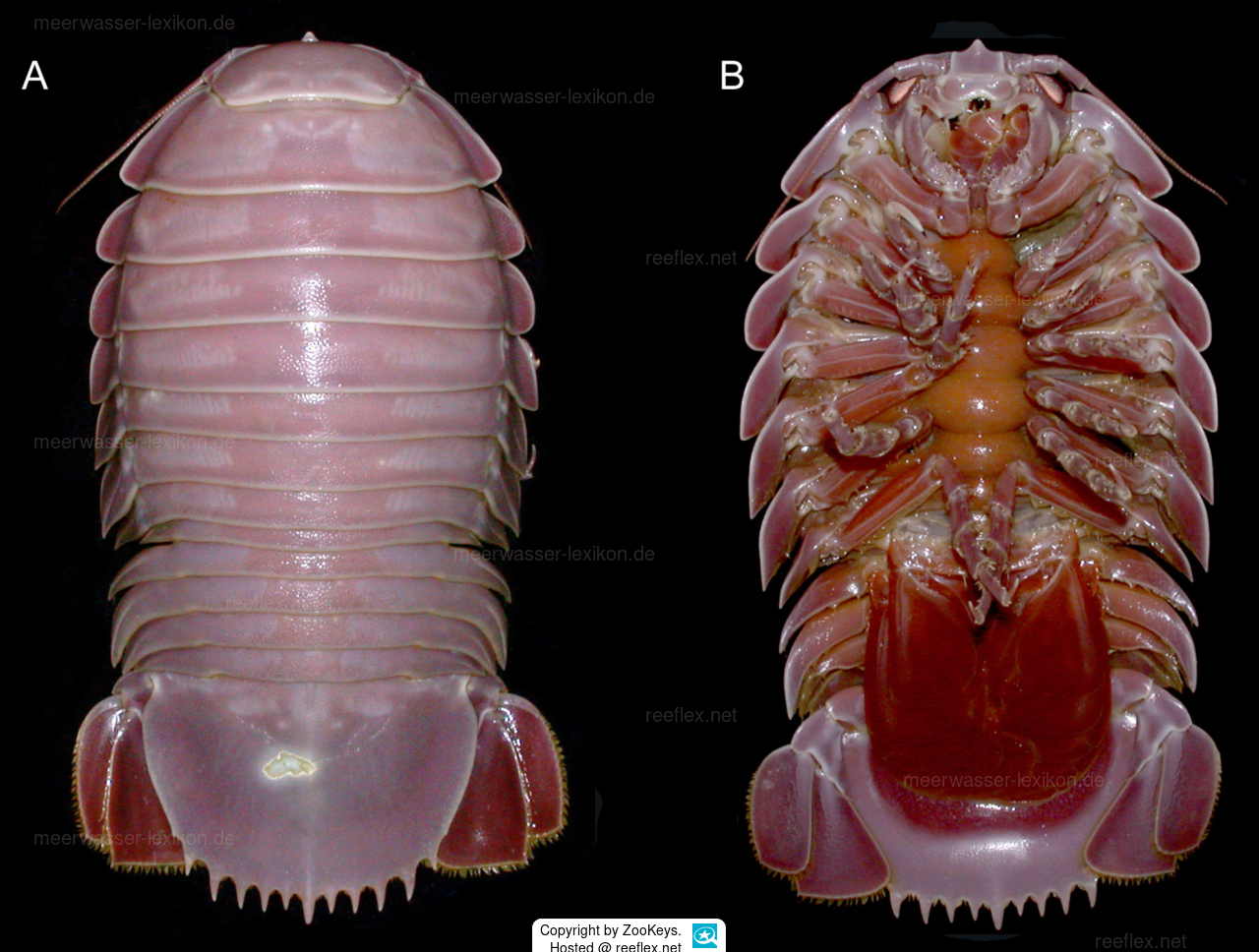
A new species of giant deep-sea isopod, Bathynomus wilsoni, was described in 2025 from the Sulu Sea in the Philippines at a depth of 2,500 meters—the deepest known location for this genus to date. A female, measuring 21.5 cm, and a male, measuring 21.2 cm, were collected using a tube trap.
The dorsal side of this giant isopod’s body is pale mauve-pink with cream-colored posterior margins of the somites.
On the ventral side, the pereonal sternites are dull orange-brown.
The pereopods, pleopods, and uropods are dark chestnut brown.
Note:
At a depth of 2,500 meters, the water pressure is 250 bar, or 2,500 metric tons per square meter, or 250 kg per square centimeter—it’s incredible that animals can live under such conditions.
Etymology
The type specimens were collected during the PAPATUA expedition of the Scripps Institution of Oceanography and brought to the Australian Museum by George D. F. (Buz) Wilson, my former professor. It is only fitting to name the new species after Buz.
Reference:
Ahyong ST, Sidabalok CM, Yang C-H, Ng PKL (2026)
Bathynomus propinquus Richardson, 1910, a valid species of supergiant deep-sea isopod from the Philippines, with notes on B. wilsoni Ahyong, 2025 (Crustacea, Isopoda, Cirolanidae).
ZooKeys 1286: 17–39. https://doi.org/10.3897/zookeys.1286.200843
Reference:
Ahyong ST, Sidabalok CM, Yang C-H, Ng PKL (2026)
Bathynomus propinquus Richardson, 1910, a valid species of supergiant deep-sea isopod from the Philippines, with notes on B. wilsoni Ahyong, 2025 (Crustacea, Isopoda, Cirolanidae).
ZooKeys 1286: 17-39. https://doi.org/10.3897/zookeys.1286.200843
This is an open access article distributed under the terms of the Creative Commons Attribution License (CC BY 4.0), which permits unrestricted use, distribution, and reproduction in any medium, provided the original author and source are credited.
The dorsal side of this giant isopod’s body is pale mauve-pink with cream-colored posterior margins of the somites.
On the ventral side, the pereonal sternites are dull orange-brown.
The pereopods, pleopods, and uropods are dark chestnut brown.
Note:
At a depth of 2,500 meters, the water pressure is 250 bar, or 2,500 metric tons per square meter, or 250 kg per square centimeter—it’s incredible that animals can live under such conditions.
Etymology
The type specimens were collected during the PAPATUA expedition of the Scripps Institution of Oceanography and brought to the Australian Museum by George D. F. (Buz) Wilson, my former professor. It is only fitting to name the new species after Buz.
Reference:
Ahyong ST, Sidabalok CM, Yang C-H, Ng PKL (2026)
Bathynomus propinquus Richardson, 1910, a valid species of supergiant deep-sea isopod from the Philippines, with notes on B. wilsoni Ahyong, 2025 (Crustacea, Isopoda, Cirolanidae).
ZooKeys 1286: 17–39. https://doi.org/10.3897/zookeys.1286.200843
Reference:
Ahyong ST, Sidabalok CM, Yang C-H, Ng PKL (2026)
Bathynomus propinquus Richardson, 1910, a valid species of supergiant deep-sea isopod from the Philippines, with notes on B. wilsoni Ahyong, 2025 (Crustacea, Isopoda, Cirolanidae).
ZooKeys 1286: 17-39. https://doi.org/10.3897/zookeys.1286.200843
This is an open access article distributed under the terms of the Creative Commons Attribution License (CC BY 4.0), which permits unrestricted use, distribution, and reproduction in any medium, provided the original author and source are credited.

