




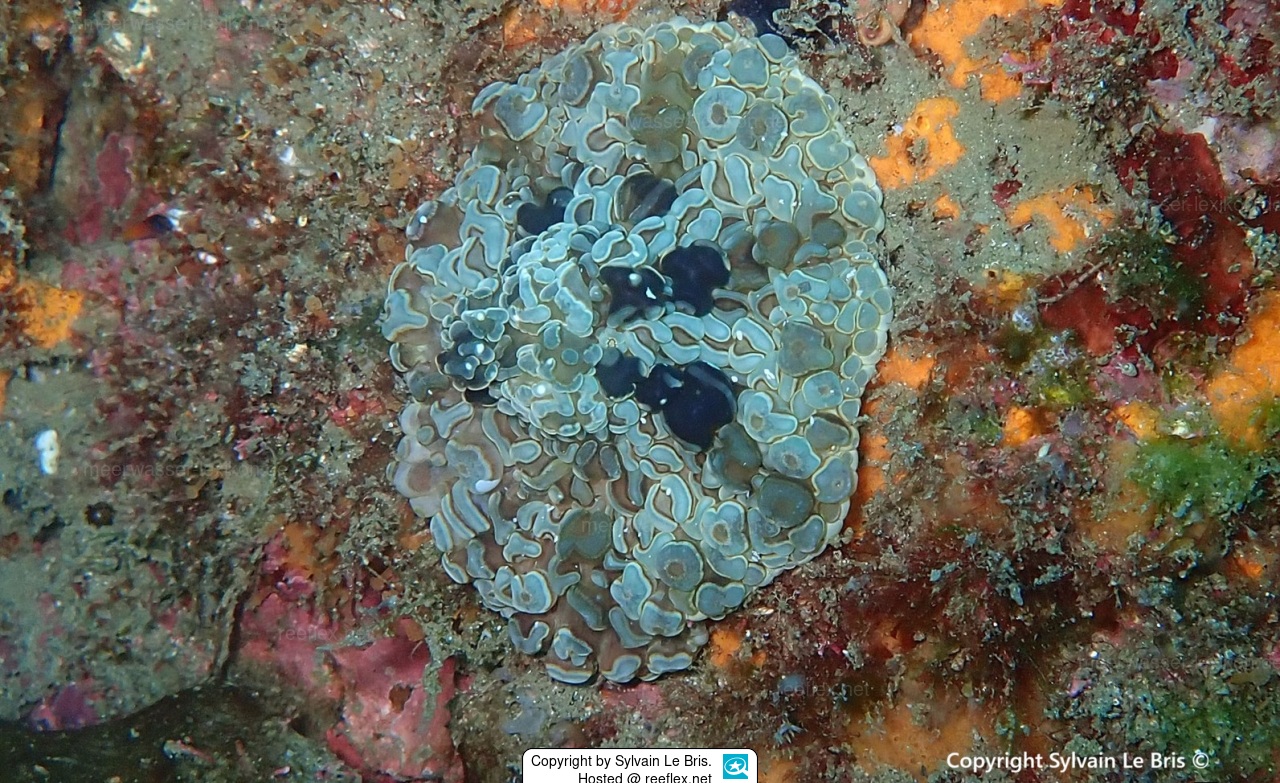
 Sylvain Le Bris, Frankreich


Info
Alicia beebei is one of currently 5 recognized species of sea anemones in the genus Alicia (as of 2026).
Alicia beebei has a well-developed, oval foot disc margin with a diameter of up to 45 mm in preserved specimens.
The column is cylindrical and elongated; in preserved specimens, it reaches a height of up to 42 mm and a diameter of up to 25 mm, and can be divided into the scapus and capitulum.
The fully extended oral disc and tentacles reach a diameter of up to 135 mm; the oral disc alone measures up to 25 mm in diameter in preserved specimens.
There are up to 96 tentacles; they are arranged in hexameres and form five cycles.
The tentacles are long, sticky, and not smooth, but densely covered with small, rounded protrusions.
Their tips tend to curl inward, and the inner tentacles are longer than the outer ones.
Mesenterial attachments are visible in the foot disc, the column, and the oral disc.
The mesenteries are arranged in a hexameric pattern across four cycles.
The first cycle is complete and sterile; the remaining cycles are incomplete.
The second and third cycles are fertile.
The species is gonochoristic.
In specimens collected in August, the oocytes have a diameter of 0.06–0.08 mm.
There are more mesenteries distally than proximally. Akontia are absent.
Two siphonoglyphs are connected to two pairs of directive mesenteries.
The retractor muscles are very weak and only slightly a
Alicia beebei has a well-developed, oval foot disc margin with a diameter of up to 45 mm in preserved specimens.
The column is cylindrical and elongated; in preserved specimens, it reaches a height of up to 42 mm and a diameter of up to 25 mm, and can be divided into the scapus and capitulum.
The fully extended oral disc and tentacles reach a diameter of up to 135 mm; the oral disc alone measures up to 25 mm in diameter in preserved specimens.
There are up to 96 tentacles; they are arranged in hexameres and form five cycles.
The tentacles are long, sticky, and not smooth, but densely covered with small, rounded protrusions.
Their tips tend to curl inward, and the inner tentacles are longer than the outer ones.
Mesenterial attachments are visible in the foot disc, the column, and the oral disc.
The mesenteries are arranged in a hexameric pattern across four cycles.
The first cycle is complete and sterile; the remaining cycles are incomplete.
The second and third cycles are fertile.
The species is gonochoristic.
In specimens collected in August, the oocytes have a diameter of 0.06–0.08 mm.
There are more mesenteries distally than proximally. Akontia are absent.
Two siphonoglyphs are connected to two pairs of directive mesenteries.
The retractor muscles are very weak and only slightly a

