Anzeige
Fauna Marin GmbH Tunze Aqua Medic Fauna Marin GmbH ICP

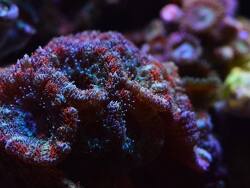
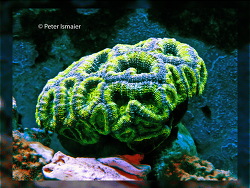
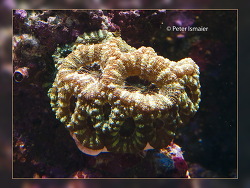
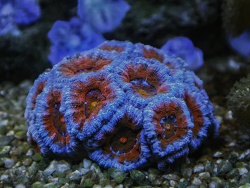
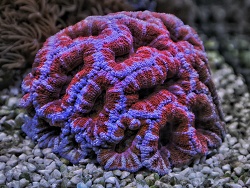
Micromussa lordhowensis Starry Cup Coral, Closed brain coral

Micromussa lordhowensis is commonly referred to as Starry Cup Coral, Closed brain coral. Difficulty in the aquarium: Average. A aquarium size of at least 200 Liter is recommended. Toxicity: Toxic hazard unknown.


Profilbild Urheber loriculus74

Acans Sven Kolschefsky


Uploaded by loriculus74.

Image detail


Profile

lexID:
1976 
AphiaID:
886929 
Scientific:
Micromussa lordhowensis 
German:
Lord Howe Island Micromussa, Großpolypige Steinkoralle 
English:
Starry Cup Coral, Closed Brain Coral 
Category:
Stony Corals LPS 
Family tree:
Animalia (Kingdom) > Cnidaria (Phylum) > Anthozoa (Class) > Scleractinia (Order) > Lobophylliidae (Family) > Micromussa (Genus) > lordhowensis (Species) 
Initial determination:
(Veron & Pichon, ), 1982 
Occurrence:
Eritrea, Djibouti, Andaman and Nicobar Islands, Australia, Banda Sea, Bunaken, China, Comores, Coral sea (Eastern Australia), East Africa, Fiji, Gulf of Aden, Indo Pacific, Indonesia, Japan, Java, Kenya, Madagascar, Malaysia, Mauritius, Mayotte, Mozambique, New Caledonia, Norfolk Island, Papua New Guinea, Philippines, Réunion , Samoa, Saudi Arabia, Singapore, Solomon Islands, Somalia, South China Sea, Sulawesi, Sumatra, Taiwan, Tansania, Thailand, The Chagos Archipelago (the Chagos Islands), the Seychelles, Timor, Vanuatu, Vietnam, Yemen 
Marine Zone:
Subtidal, sublittoral, infralittoral, deep zone of the oceans from the lower limit of the intertidal zone (intertidal) to the shelf edge at about 200 m water depth. neritic. 
Sea depth:
1 - 30 Meter 
Habitats:
Coral reefs, Reef-associated, Seawater, Sea water 
Size:
up to 7.87" (20 cm) 
Temperature:
73.94 °F - 84.74 °F (23.3°C - 29.3°C) 
Food:
Plankton, Zooxanthellae / Light 
Tank:
44 gal (~ 200L)  
Difficulty:
Average 
Offspring:
Possible to breed 
Toxicity:
Toxic hazard unknown 
CITES:
Appendix II ((commercial trade possible after a safety assessment by the exporting country)) 
Red List:
Endangered (EN) 
More related species
in this lexicon:
 
Author:
Publisher:
Meerwasser-Lexikon.de
Created:
Last edit:
2026-04-14 19:13:07 

Captive breeding / propagation

The offspring of Micromussa lordhowensis are possible. Unfortunately, the number of offspring is not large enough to cover the demand of the trade. If you are interested in Micromussa lordhowensis, please ask your dealer for offspring. If you already own Micromussa lordhowensis, try breeding yourself. This will help to improve the availability of offspring in the trade and to conserve natural stocks.

Info

Micromussa lordhowensis (Veron & Pichon, 1982)

From Veron, J.E.N. Corals of the World

Description: Colonies are massive and cerioid, with laterally compressed corallites of uneven height. Walls are acute: septa are thick, with large teeth. Columellae are barely developed. Colonies have a thick fleshy mantle which is covered by fine papillae.

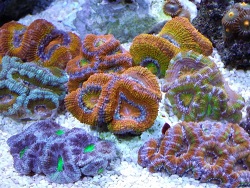
Color: Very colourful: red, purple and green are the most common colours, with corallites and walls almost always of contrasting colours.

Similar Species: Micromussa amakusensis. See also Acanthastrea echinata.

Synonymised names
Acanthastrea lordhowensis Veron & Pichon, 1982 · unaccepted > superseded combination (basionym)
Korallenriff Magazin

Cover Korallenriff Magazin Ausgabe 18

Ausgabe #18
Das Aqua-Porträt

Ein Bericht, der zeigen soll, wie wenig notwendig ist, um ein schönes Riffbecken zu pflegen. Eigentlich sollte nach einem Umzug meine Reise in die Welt der Meerwasseraquaristik und in der Aquaristik generell enden.

Weiterlesen

External links

  1. Corals of the World (en). Abgerufen am 07.08.2020.
  2. Reef Builders (en). Abgerufen am 07.08.2020.
  3. Reefkeeping.com (en). Abgerufen am 07.08.2020.

Pictures

Commonly

Micromussa lordhowensis Großpolypige Steinkoralle
1
Micromussa lordhowensis Großpolypige Steinkoralle
1
Acanthastrea echinata Großpolypige Steinkoralle
1
Acanthastrea lordhowensis (c) by Simone Chand
1
“From J.E.N. Charlie Veron, J.E.N. Corals of the World.”, Foto Great Barrier Reef, Australien
1
Copyright Charlie J.E.N. Veron, Foto von den Norfork Inseln
1
Acanthastrea lordhowensis (c) by De Jong Marinelife
1
Acanthastrea lordhowensis (c) by De Jong Marinelife
1
Acanthastrea lordhowensis (c) by De Jong Marinelife
1
copyright DeJong Marinelife
1

Husbandry know-how of owners

am 27.12.11#2
Acanthastreas sind bei mir sehr robust und wachsen auch recht schnell. Hilfreich dabei ist eine regelmäßige Fütterung. Ich habe sehr gute Erfahrungen mit Ultra LPS von Fauna Marin gemacht - finde das Futter allerdings unverschämt teuer.
Bei der Teilung etwas größerer Stöcke gehe ich sehr unsensibel mit Stemmeisen und kleinem Hammer vor, so dass einzelne Polypen häufig beschädigt werden. Bei mir zeigen Acanthastreas ein erstaunliches Regenerationsvermögen. Noch nie ist ein so brachial geteilter Polyp eingegangen. Ich versuche darauf zu achten, dass die geteilten Fragmente aus mehreren Polypen bestehen und klebe sie mit handelsüblichem Kleber auf Ablegersteine
2 husbandary tips from our users available
Show all and discuss

What's that ?

The following is an overview of "what's that?" Entries that have been successfully determined and assigned to this entry. A look at the entertainments there is certainly interesting.