


 David Lehrian


Info
Caranx latus Agassiz, 1831
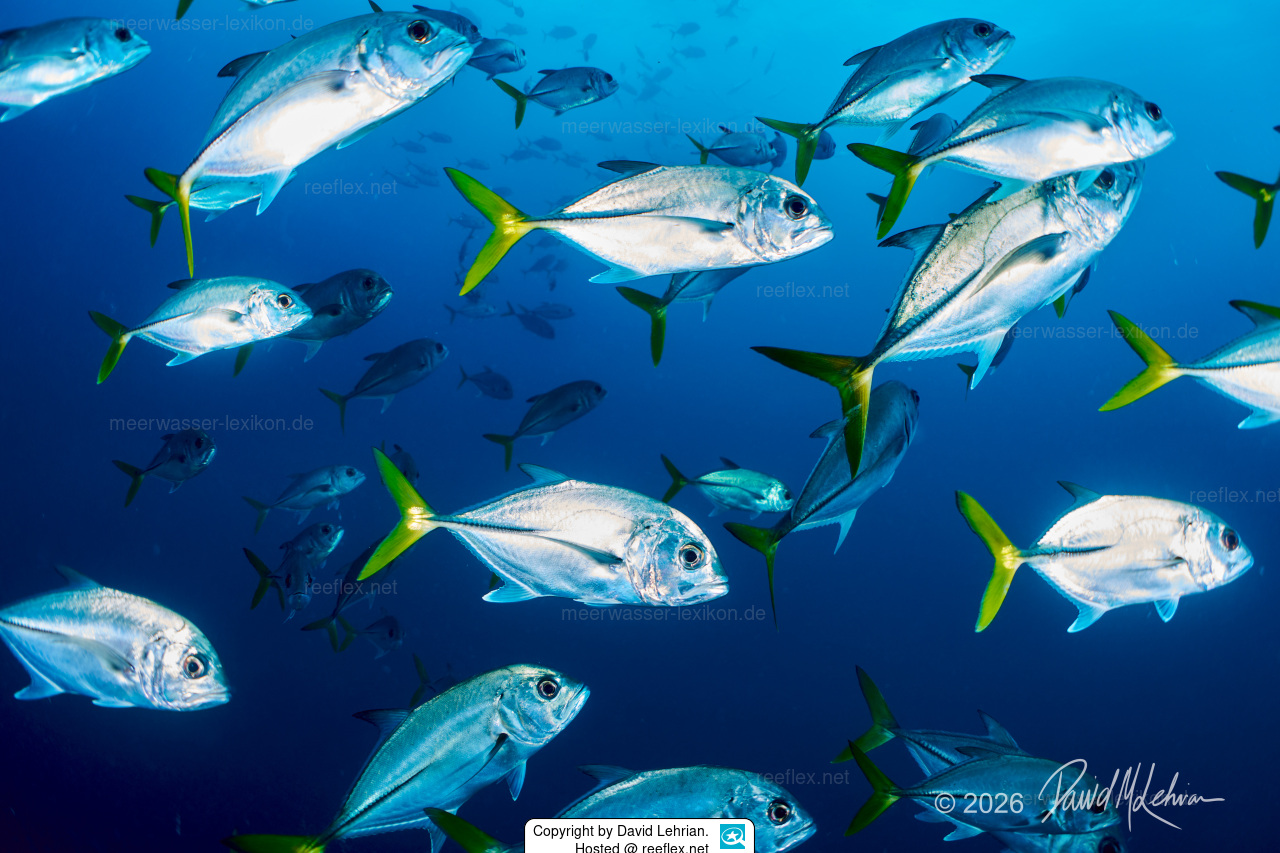
Caranx latus, also known as horse eye jack, are found in the western Atlantic from the coast of New Jersey southeast to Bermuda, in the Gulf of Mexico to the north coast of Brazil.
Horse eye jack are similar in body shape Caranx caninus, but her head is less steep. Typical is a small blackish spot on the edge of the gill cover, usually poorly defined or even not exist. They show no spots on the pectoral fin, the tail fin is yellow. Juvenils show often wider dark stripes on the body. For a reef aquarium, they are much too large (75 cm) and are therefore unsuitable.
fishbase: Reports of ciguatera poisoning
Consuming this animal can trigger the dreaded Ciguatera fish poisoning.
The cause is to be found in certain unicellular organisms (dinoflagellates, such as Gambierdiscus toxicus), which produce toxins in the body of harmless and otherwise well-tolerated food fish, which can lead to various symptoms in humans:
Initial symptoms: Sweating, numbness and burning, especially around the mouth.
This is followed later by chills, dizziness, nausea, vomiting, diarrhoea, abdominal pain and muscle cramps. Paresthesia (itching, tingling, numbness) on the lips, the mucous membrane of the mouth and especially on the palms of the hands and soles of the feet, numbness in the hands, feet and face.
Paralysis of the skeletal muscles, including the respiratory muscles, dizziness and coordination disorders may occur. Muscle pain, joint pain, headache, toothache, shivering and sweating are further symptoms. A general feeling of weakness develops. Consumption of alcohol aggravates the symptoms.
Less common are life-threatening drops in blood pressure and palpitations (tachycardia) or the opposite. Overall, the condition is very rare, but it leads to death in about 7% of cases.
Attention: An antidote does not exist!
First aid:
As early as possible: Pump out the stomach, if vomiting does not occur by itself
Activated carbon (medical carbon) give to bind the toxins: dosage is 1 g / kg body weight.
Promote excretion: As an acute therapy, the attending physician can give an infusion of 20% mannitol (sugar alcohol). The mechanism of action is unclear. Mannitol promotes urine excretion, so this measure should only be taken after fluid and electrolytes have been supplemented to prevent a circulatory collapse.
Rehydration with fluid and electrolytes is a sensible measure anyway, especially after vomiting and diarrhoea.
In life-threatening situations, plasma expanders should be given, i.e. infusions that increase the volume of the blood and remain in the circulation for a long time.
Cardiovascular symptoms may require further medical intervention: Atropine can be given if the heartbeat slows down, dopamine if the blood pressure drops.
You can find more information here:
http://www.dr-bernhard-peter.de/Apotheke/seite116.htm
Synonymised names:
Carangus aureus Poey, 1875 · unaccepted
Caranx fallax Cuvier, 1833 · unaccepted
Caranx lepturus Agassiz, 1831 · unaccepted
Caranx richardi Holbrook, 1855 · unaccepted
Xurel lata Agassiz, 1831 · unaccepted
Caranx latus, also known as horse eye jack, are found in the western Atlantic from the coast of New Jersey southeast to Bermuda, in the Gulf of Mexico to the north coast of Brazil.
Horse eye jack are similar in body shape Caranx caninus, but her head is less steep. Typical is a small blackish spot on the edge of the gill cover, usually poorly defined or even not exist. They show no spots on the pectoral fin, the tail fin is yellow. Juvenils show often wider dark stripes on the body. For a reef aquarium, they are much too large (75 cm) and are therefore unsuitable.
fishbase: Reports of ciguatera poisoning
Consuming this animal can trigger the dreaded Ciguatera fish poisoning.
The cause is to be found in certain unicellular organisms (dinoflagellates, such as Gambierdiscus toxicus), which produce toxins in the body of harmless and otherwise well-tolerated food fish, which can lead to various symptoms in humans:
Initial symptoms: Sweating, numbness and burning, especially around the mouth.
This is followed later by chills, dizziness, nausea, vomiting, diarrhoea, abdominal pain and muscle cramps. Paresthesia (itching, tingling, numbness) on the lips, the mucous membrane of the mouth and especially on the palms of the hands and soles of the feet, numbness in the hands, feet and face.
Paralysis of the skeletal muscles, including the respiratory muscles, dizziness and coordination disorders may occur. Muscle pain, joint pain, headache, toothache, shivering and sweating are further symptoms. A general feeling of weakness develops. Consumption of alcohol aggravates the symptoms.
Less common are life-threatening drops in blood pressure and palpitations (tachycardia) or the opposite. Overall, the condition is very rare, but it leads to death in about 7% of cases.
Attention: An antidote does not exist!
First aid:
As early as possible: Pump out the stomach, if vomiting does not occur by itself
Activated carbon (medical carbon) give to bind the toxins: dosage is 1 g / kg body weight.
Promote excretion: As an acute therapy, the attending physician can give an infusion of 20% mannitol (sugar alcohol). The mechanism of action is unclear. Mannitol promotes urine excretion, so this measure should only be taken after fluid and electrolytes have been supplemented to prevent a circulatory collapse.
Rehydration with fluid and electrolytes is a sensible measure anyway, especially after vomiting and diarrhoea.
In life-threatening situations, plasma expanders should be given, i.e. infusions that increase the volume of the blood and remain in the circulation for a long time.
Cardiovascular symptoms may require further medical intervention: Atropine can be given if the heartbeat slows down, dopamine if the blood pressure drops.
You can find more information here:
http://www.dr-bernhard-peter.de/Apotheke/seite116.htm
Synonymised names:
Carangus aureus Poey, 1875 · unaccepted
Caranx fallax Cuvier, 1833 · unaccepted
Caranx lepturus Agassiz, 1831 · unaccepted
Caranx richardi Holbrook, 1855 · unaccepted
Xurel lata Agassiz, 1831 · unaccepted


