

 Pauline Walsh Jacobson, USA

Info
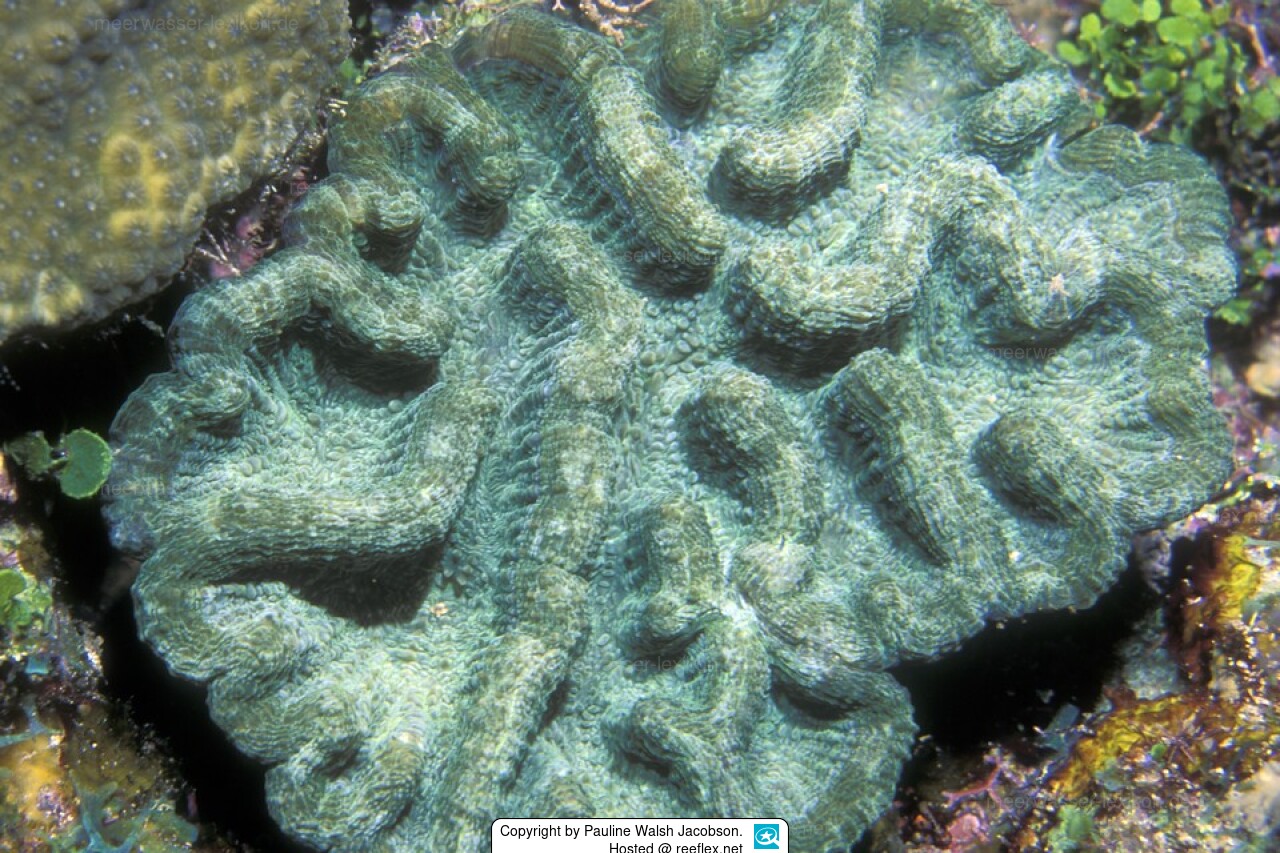
Manicina areolata (Linnaeus, 1758)
Description: Colonies are either free-living or attached; the former have a cone-shaped undersurface. Small colonies are oval shaped and consist of a central axial valley with short side valleys. Larger colonies are hemispherical and meandroid. There is a conspicuous ambulacral groove along the tops of valley walls. Septa are thick and even.
Color: Usually uniform pale orange-brown but may be a variety of browns, greys and greens with contrasting colours of valleys and walls. Habitat: Subtidal seagrass beds where colonies are small and free-living, also shallow reef environments where colonies are attached and become hemispherical.
Abundance: Usually uncommon.
Similar Species: Colpophyllia natans. Small colonies resemble Diploria labyrinthiformis and the species generally resembles the trachyphyllid Trachyphyllia geoffroyi.
Synonymised names:
Madrepora areolata Linnaeus, 1758
Maeandra areolata (Linnaeus, 1758) (previous combination, synonym)
Maeandra areolata var. angusta (Dana, 1846) (synonymy)
Maeandra areolata var. colummelaris Verrill, 1901 (previous combination, synonym)
Maeandra areolata var. confertifolia Verrill, 1901 (previous combination, synonym)
Maeandra areolata var. laxifolia Verrill, 1901 (previous combination, synonym)
Manicina areolata f. areolata (Linnaeus, 1758) (synonym)
Manicina areolata f. mayori Wells, 1936 (synonym)
Manicina areolata var. angusta Dana, 1846 (synonymy)
Manicina areolata var. gracilis Dana, 1846 (synonymy)
Manicina crispata Milne Edwards & Haime, 1849 (synonymy)
Manicina gyrosa (Ellis & Solander, 1786) (synonymy)
Manicina hispida Ehrenberg, 1834 (synonymy)
Manicina praerupta Ehrenberg, 1834 (synonymy)
Manicina sebacana Milne Edwards & Haime, 1849 (synonymy)
Manicina strigilis Milne Edwards & Haime, 1849 (synonymy)
Manicina valenciennesi Milne Edwards & Haime, 1849 (synonymy)
Meandrina areolata (Linnaeus, 1758) (changed combination)
Podasteria gyrosa (Ellis & Solander, 1786) (synonymy)
Podasteria mayori Wells, 1936 (synonymy)
Direct children (4):
Forma Manicina areolata f. areolata (Linnaeus, 1758) accepted as Manicina areolata (Linnaeus, 1758) (synonym)
Forma Manicina areolata f. mayori Wells, 1936 accepted as Manicina areolata (Linnaeus, 1758) (synonym)
Variety Manicina areolata var. angusta Dana, 1846 accepted as Manicina areolata (Linnaeus, 1758) (synonymy)
Variety Manicina areolata var. gracilis Dana, 1846 accepted as Manicina areolata (Linnaeus, 1758) (synonymy)
Description: Colonies are either free-living or attached; the former have a cone-shaped undersurface. Small colonies are oval shaped and consist of a central axial valley with short side valleys. Larger colonies are hemispherical and meandroid. There is a conspicuous ambulacral groove along the tops of valley walls. Septa are thick and even.
Color: Usually uniform pale orange-brown but may be a variety of browns, greys and greens with contrasting colours of valleys and walls. Habitat: Subtidal seagrass beds where colonies are small and free-living, also shallow reef environments where colonies are attached and become hemispherical.
Abundance: Usually uncommon.
Similar Species: Colpophyllia natans. Small colonies resemble Diploria labyrinthiformis and the species generally resembles the trachyphyllid Trachyphyllia geoffroyi.
Synonymised names:
Madrepora areolata Linnaeus, 1758
Maeandra areolata (Linnaeus, 1758) (previous combination, synonym)
Maeandra areolata var. angusta (Dana, 1846) (synonymy)
Maeandra areolata var. colummelaris Verrill, 1901 (previous combination, synonym)
Maeandra areolata var. confertifolia Verrill, 1901 (previous combination, synonym)
Maeandra areolata var. laxifolia Verrill, 1901 (previous combination, synonym)
Manicina areolata f. areolata (Linnaeus, 1758) (synonym)
Manicina areolata f. mayori Wells, 1936 (synonym)
Manicina areolata var. angusta Dana, 1846 (synonymy)
Manicina areolata var. gracilis Dana, 1846 (synonymy)
Manicina crispata Milne Edwards & Haime, 1849 (synonymy)
Manicina gyrosa (Ellis & Solander, 1786) (synonymy)
Manicina hispida Ehrenberg, 1834 (synonymy)
Manicina praerupta Ehrenberg, 1834 (synonymy)
Manicina sebacana Milne Edwards & Haime, 1849 (synonymy)
Manicina strigilis Milne Edwards & Haime, 1849 (synonymy)
Manicina valenciennesi Milne Edwards & Haime, 1849 (synonymy)
Meandrina areolata (Linnaeus, 1758) (changed combination)
Podasteria gyrosa (Ellis & Solander, 1786) (synonymy)
Podasteria mayori Wells, 1936 (synonymy)
Direct children (4):
Forma Manicina areolata f. areolata (Linnaeus, 1758) accepted as Manicina areolata (Linnaeus, 1758) (synonym)
Forma Manicina areolata f. mayori Wells, 1936 accepted as Manicina areolata (Linnaeus, 1758) (synonym)
Variety Manicina areolata var. angusta Dana, 1846 accepted as Manicina areolata (Linnaeus, 1758) (synonymy)
Variety Manicina areolata var. gracilis Dana, 1846 accepted as Manicina areolata (Linnaeus, 1758) (synonymy)


