


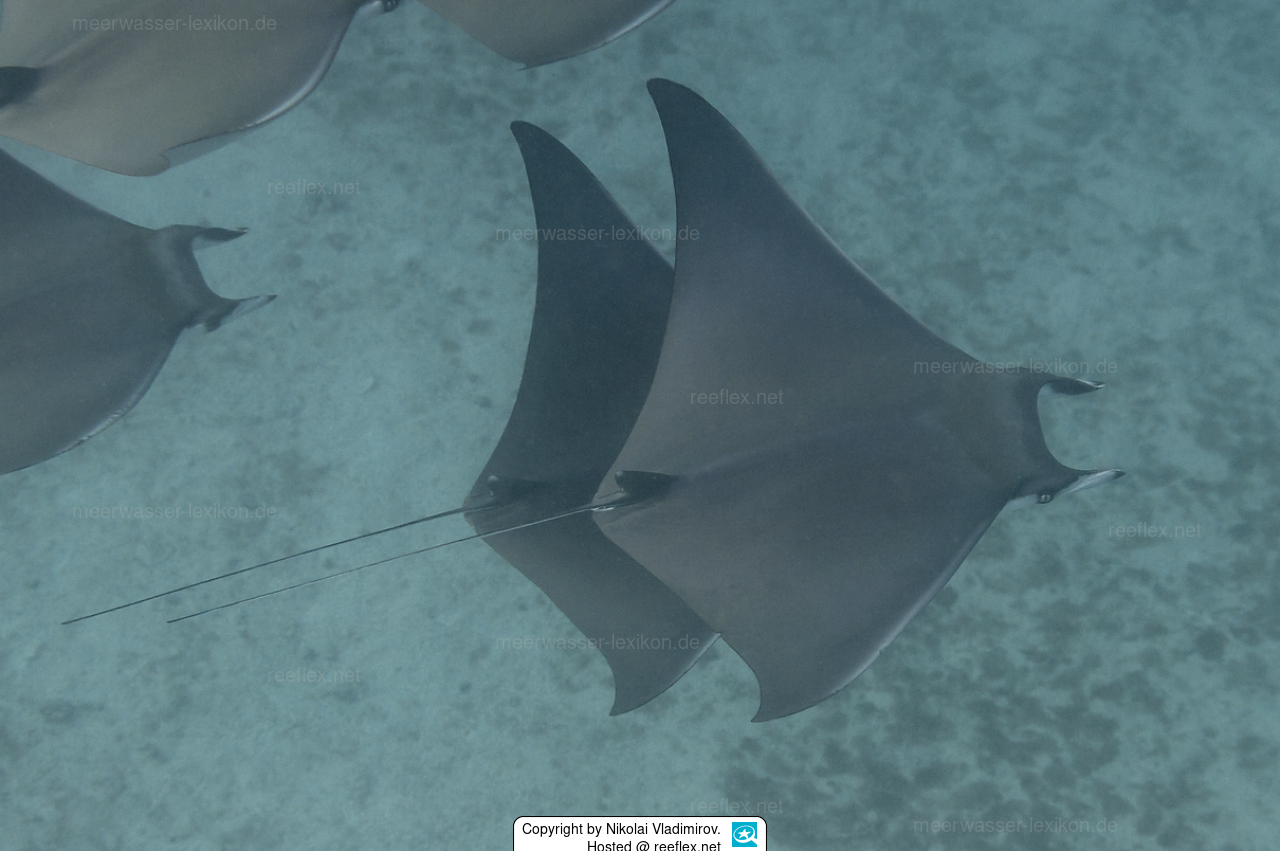
 Nikolai Vladimirov, Russland


Info
Very special thanks for the first photo of Mobula kuhlii to Nikolai Vladimirov from Nikolai Vladimirov!
The shortfin devil ray is a nearshore species that occurs mainly on the shelf in continental coastal areas to 50 meters depth.
The species was named after Heinrich Kuhl, a German zoologist and passionate collector of zoological specimens in the 19th century.
specimens in the Dutch East Indies from the 19th century.
Mobula kuhlii is a viviparous species and is one of the smallest devil rays.
Devil rays, despite their name, are harmless zooplankton feeders that continuously migrate through the oceans, eating the smallest organisms from the water column, which they direct to their mouths with the help of their head lobes.
Synonyms:
Cephaloptera eregoodootenkee Bleeker, 1859
Cephaloptera kuhlii Müller & Henle, 1841
Dicerobatis draco Günther, 1872
Dicerobatis eregoodoo Cantor, 1849
Mobula eregoodoo (Cantor, 1849)
Mobula eregoodootenkee (Bleeker, 1859)
The shortfin devil ray is a nearshore species that occurs mainly on the shelf in continental coastal areas to 50 meters depth.
The species was named after Heinrich Kuhl, a German zoologist and passionate collector of zoological specimens in the 19th century.
specimens in the Dutch East Indies from the 19th century.
Mobula kuhlii is a viviparous species and is one of the smallest devil rays.
Devil rays, despite their name, are harmless zooplankton feeders that continuously migrate through the oceans, eating the smallest organisms from the water column, which they direct to their mouths with the help of their head lobes.
Synonyms:
Cephaloptera eregoodootenkee Bleeker, 1859
Cephaloptera kuhlii Müller & Henle, 1841
Dicerobatis draco Günther, 1872
Dicerobatis eregoodoo Cantor, 1849
Mobula eregoodoo (Cantor, 1849)
Mobula eregoodootenkee (Bleeker, 1859)

